The Veil Nebula Complex
Click to Zoom
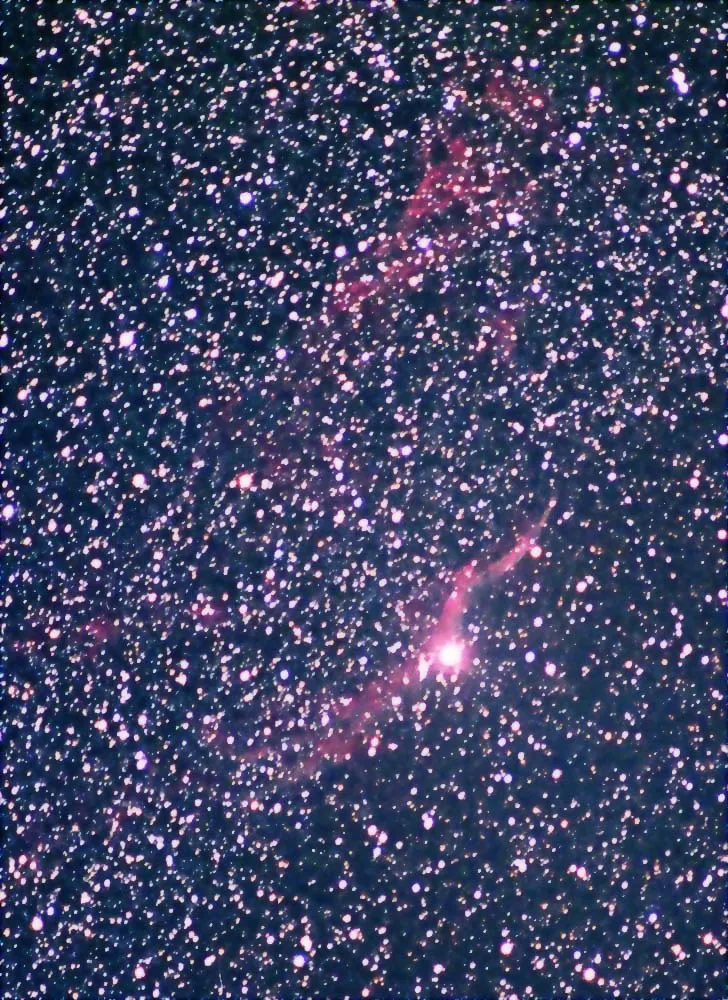
An early film exposure of the Veil Nebula in Cygnus. A later, deeper CCD attempt, a wide-field full-complex color mosaic, and a more recent bicolor image are also on file.
Location: Texas Star Party 2003 near Fort Davis, Texas
Seeing: 7/10
Transparency: 9/10
Date and Time: May 2, 2003 @ 4:15 AM CST
Equipment: 420mm @ f4 (300mm Nikkor ED lens with TC14B teleconverter) guided with Meade 208xt
Length: Single 60 minute exposure
Film: Kodak Royal Gold 400
Processing Information: Image is greatly cropped with a levels adjustment and substantial contrast increase. Slight unsharp mask applied.
Exposure Notes: Missed perfect focus just slightly on this object. I also missed the composition, as I should have placed 52 Cygni at the right side of the shot so as to capture the entire nebula. Hence, I cropped it down in processing.
- What it is
- The Veil Nebula is the sprawling remnant of a massive star that exploded as a supernova an estimated 10,000–20,000 years ago — the full complex includes the western "Witch's Broom" (NGC 6960), the eastern arc (NGC 6992/6995), and central wisps (Pickering's Triangle).
- Constellation
- Cygnus
- Distance
- ~2,400 light-years
- Apparent magnitude
- ~7 (individual filaments)
- Angular size
- ~3° overall
- Coordinates
- RA ~20h 45m–20h 57m, Dec ~+30°–+32°
This summary was generated by an AI assistant from general astronomical references, not from Jay's own notes on this specific image. Treat every detail above as a starting point for research, not settled fact.