NGC 6960 - The Veil Nebula (2003)
Click to Zoom
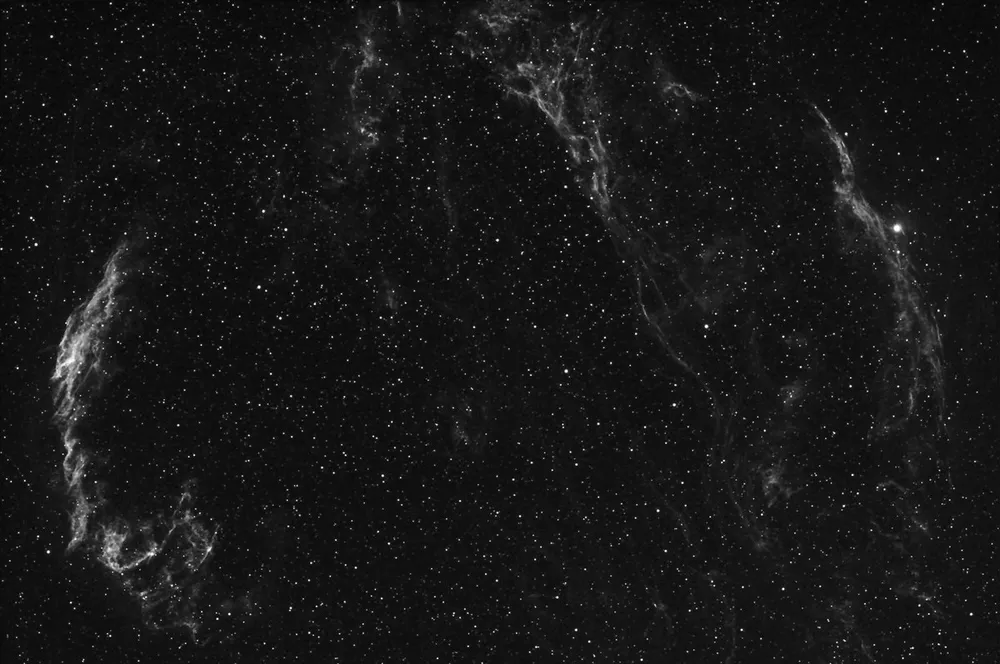
The Veil Nebula in Cygnus, in grayscale Hydrogen-Alpha. An earlier film attempt, a wide-field full-complex color mosaic, and a more recent bicolor image are also on file.
Location: Texas Star Party 2004 near Fort Davis, Texas
Seeing: 8/10
Transparency: 9/10
Date and Time: May 19, 2003
Equipment: Tak FSQ-106 on Tak NJP mount
Camera: SBIG STL-6303E, self-guided
Filter: Custom Scientific 5 nm H-alpha filter
Exposure information: Grayscale, 60 minutes (10 min sub-exposures)
Processing Information: Calibration, deblooming, alignment, and Sigma combine in MaxIm 4. Curves, Levels, and selective, iterative Unsharp Mask in Photoshop CS.
Exposure Notes: This was my first attempt at using the 5 nm H-alpha filter that is integrated into the STL-6303E. I didn't have as difficult a time finding a guidestar as I originally feared.
- What it is
- NGC 6960, nicknamed the "Witch's Broom" or "Filamentary Nebula," is the western arc of the Veil Nebula, the expanding wreckage of a star that exploded as a supernova an estimated 10,000–20,000 years ago.
- Constellation
- Cygnus
- Distance
- ~2,400 light-years
- Apparent magnitude
- ~7
- Angular size
- ~70 × 6 arcminutes
- Coordinates
- RA 20h 45m, Dec +30° 43′
This summary was generated by an AI assistant from general astronomical references, not from Jay's own notes on this specific image. Treat every detail above as a starting point for research, not settled fact.