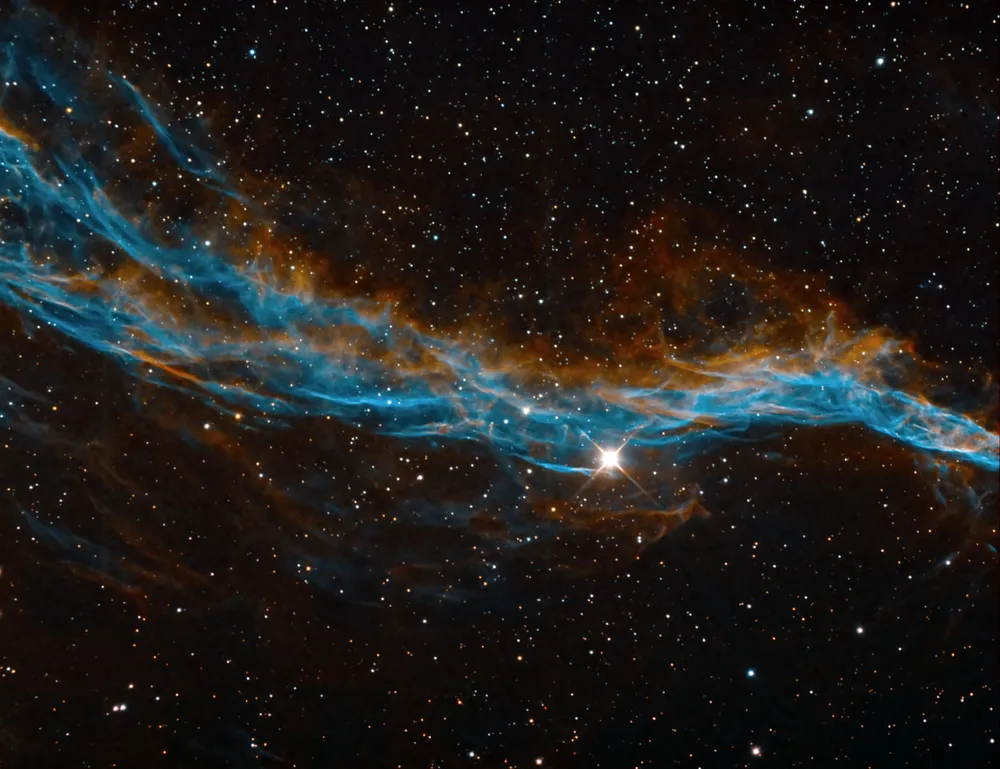
NGC 6960 - Witch's Broom in Bicolor
Click to Zoom
NGC 6960, the Witch’s Broom, in a bicolor hydrogen/oxygen palette. A 2003 grayscale attempt and a wide-field full-complex color mosaic are also on file. This image is also covered in a blog post.
Location: Comanche Springs Astronomy Campus
Date: June 2018
Scope/Mount: 12.5" RCOS RC on a Paramount ME
Camera: FLI PL-16803
Filters: AstroDon 3nm spectral band filters (Ha, OIII)
Exposure Info: Bicolor image, 2 hours total data (1 hour ionized hydrogen, 1 hour ionized oxygen)
Processing Information: Bicolor palette -- hydrogen (H-alpha) data mapped to the red channel, oxygen (OIII) data mapped to the blue channel, and a 70/30 percent blend of OIII and H-alpha respectively assigned to the green channel.
Extra Notes: Data found on the Conley Observatory server at the Three Rivers Foundation, taken with students during the week-long "Astrophysics in a Nutshell" course.
- What it is
- NGC 6960, nicknamed the "Witch's Broom" or "Filamentary Nebula," is the western arc of the Veil Nebula, the expanding wreckage of a star that exploded as a supernova an estimated 10,000–20,000 years ago.
- Constellation
- Cygnus
- Distance
- ~2,400 light-years
- Apparent magnitude
- ~7
- Angular size
- ~70 × 6 arcminutes
- Coordinates
- RA 20h 45m, Dec +30° 43′
This summary was generated by an AI assistant from general astronomical references, not from Jay's own notes on this specific image. Treat every detail above as a starting point for research, not settled fact.