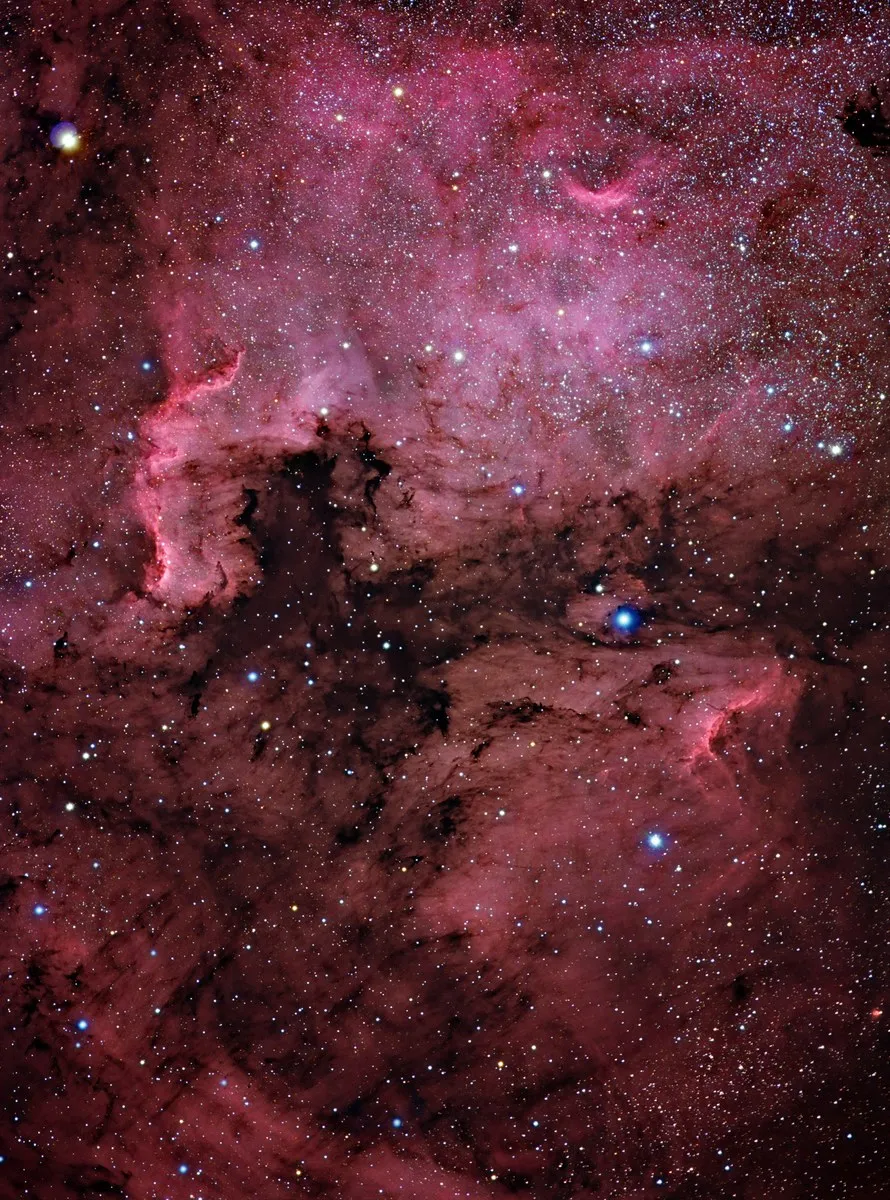
North America and The Pelican
Click to Zoom
NGC 7000 and IC 5067/70 — the North America and Pelican Nebulae — in Ha+LRGB. Earlier attempts are on file: an HaRGB blend and a plain LRGB version, both from 2004, plus a quick DSLR shot from 2018.
Location: Okie-Tex Star Party, Kenton, OK
Date: September 18-19, 2006
Seeing: 3/10
Transparency: 9/10
Temperature: -25 degrees C on camera
Scope/Mount: Tak FSQ-106 @ f/5 on Paramount ME
Camera: SBIG STL-11000M astro CCD camera
Filter: Custom Scientific 4.5 nm H-alpha filter
Exposure Info: Ha+LRGB image; 150:60:30:40 minutes (10 minute subexposures for LRGB, 30 minute subexposures for Ha)
Processing Information: Acquisition with CCDSoft. Calibration (darks/flats), and registration in CCDstack (median combine). RGB combine and Ha blending, color balance, levels/curves, and noise removal/local contrast enhancement (Noel Carboni's Astronomy Tools) in Photoshop CS.
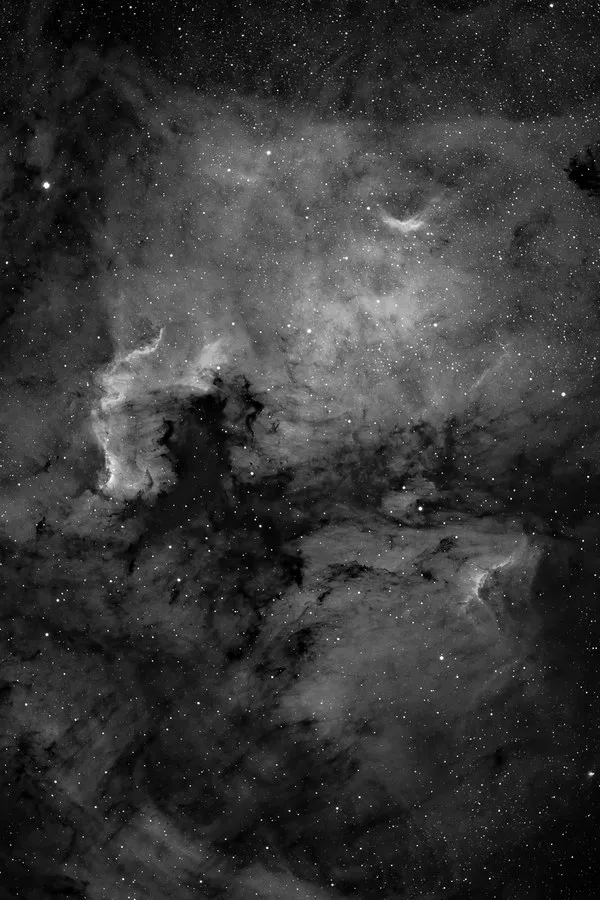
Hydrogen Alpha data used for the image above (150 minutes)
- What it is
- NGC 7000, the North America Nebula, and IC 5070, the Pelican Nebula, are a pair of large emission nebulae separated by a lane of obscuring dust, though they are part of the same enormous star-forming cloud.
- Constellation
- Cygnus
- Distance
- ~2,590 ly (NGC 7000); ~1,800–2,000 ly (IC 5070)
- Apparent magnitude
- ~4 (NGC 7000); ~8 (IC 5070)
- Angular size
- ~120 × 100′ (NGC 7000); ~60 × 50′ (IC 5070)
- Coordinates
- NGC 7000: RA 20h 59m 17s, Dec +44° 31′
This summary was generated by an AI assistant from general astronomical references, not from Jay's own notes on this specific image. Treat every detail above as a starting point for research, not settled fact.