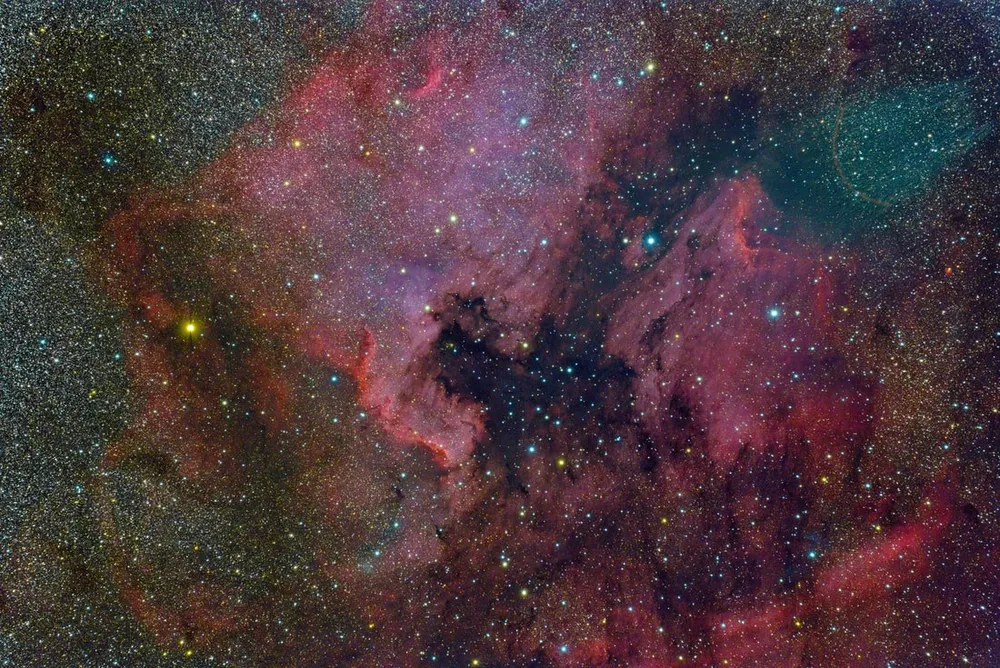
North America and Pelican Nebulae (DSLR)
Click to Zoom
The North America and Pelican Nebula region in Cygnus, one of five wide-field DSLR shots taken during a summer astrophysics workshop. A later, deeper CCD attempt of the same region is also on file. Also from this DSLR session: M31, the Lagoon/Trifid region, the M16/M17 region, and the Rho-Antares region. This image is also covered in a blog post.
Location: Comanche Springs Astronomy Campus
Date: June 2018
Scope/Mount: Takahashi FSQ-85ED ("Baby-Q") apo refractor @ f/5.3 on a Takahashi NJP mount
Camera: Nikon D810a DSLR
Exposure Info: 42 minutes total (2 minute subs, ISO 1600)
Extra Notes: Unattended and unguided -- polar aligned and pointed manually with the finder scope, then left to run on an on-camera intervalometer while the "Astrophysics in a Nutshell" workshop students worked on other things.
- What it is
- NGC 7000, the North America Nebula, and IC 5070, the Pelican Nebula, are a pair of large emission nebulae separated by a lane of obscuring dust, though they are part of the same enormous star-forming cloud.
- Constellation
- Cygnus
- Distance
- ~2,590 ly (NGC 7000); ~1,800–2,000 ly (IC 5070)
- Apparent magnitude
- ~4 (NGC 7000); ~8 (IC 5070)
- Angular size
- ~120 × 100′ (NGC 7000); ~60 × 50′ (IC 5070)
- Coordinates
- NGC 7000: RA 20h 59m 17s, Dec +44° 31′
This summary was generated by an AI assistant from general astronomical references, not from Jay's own notes on this specific image. Treat every detail above as a starting point for research, not settled fact.