Horsehead and Flame Nebula Region
Click to Zoom
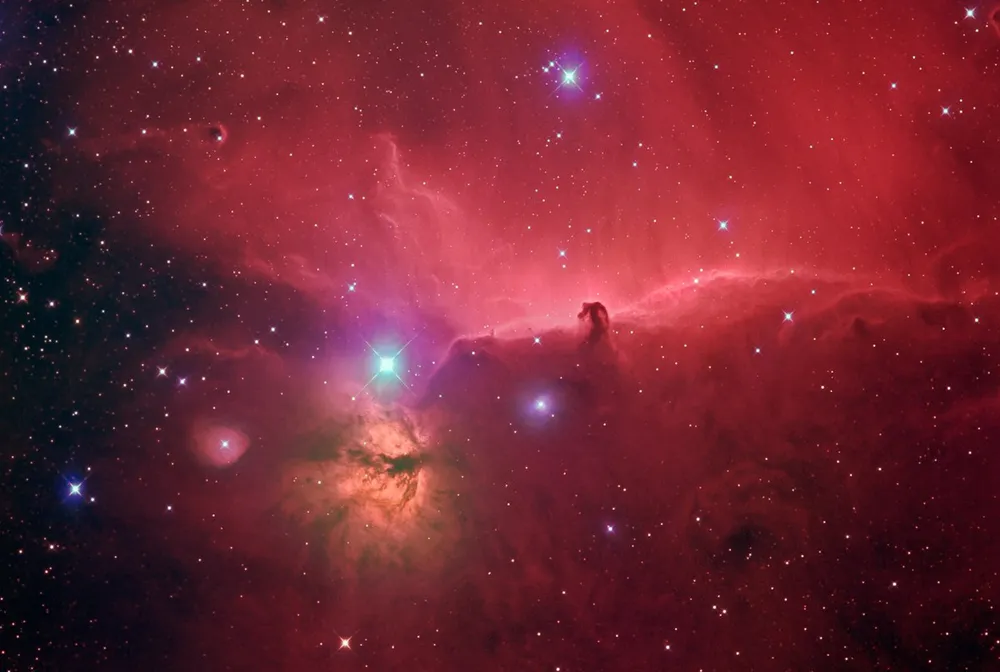
The Horsehead Nebula region — B33 and the Flame Nebula, NGC 2024, in Ha(Ha)GB. A closer, later view of B33 alone is also on file.
Date: December 6, 2004
Location: The Ballauer Observatory near Azle, Texas
Transparency: 4.5 mag zenithal
Seeing: 3/10
Temperature: 55 degrees, camera cooled to -25 degrees C
Scope/Mount: Tak FSQ-106 @ f/5 and Tak NJP mount
Camera: SBIG STL-6303E, self-guided
Exposure Info: Ha(Ha)GB, 150 minutes Ha luminance (8 x 15 minutes); 15 x 2 minutes green and blue; all unbinned.
Processing: Dark frame calibration, deblooming, registration, and Sigma Combine in MaxIm DL 4. Digital Development and RGB combine in MaxIm DL 4. Color balance, curves, levels, selective sharpening/blurring/despeckle in Photoshop CS. Masking of additional H-alpha luminance performed in Photoshop CS.
Extra Notes: An additional 30 minutes of h-alpha luminance was taken December 9, 2004. This allowed for more detail in the foreground.
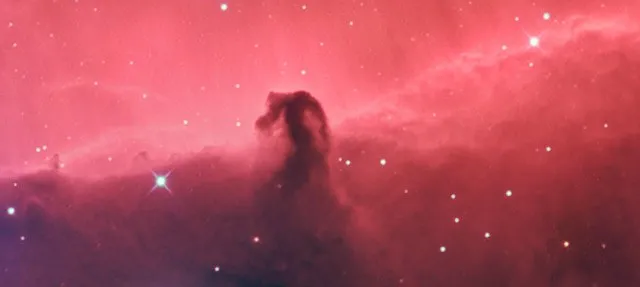
The Horsehead Nebula, B33, shown at close to the full resolution of the camera
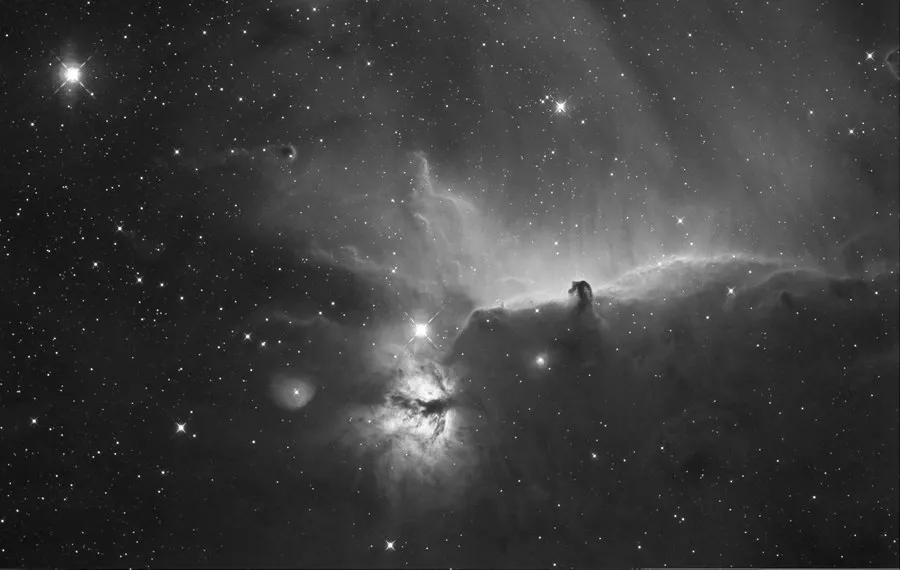
The Horsehead Nebula region in Hydrogen-Alpha light, used for luminance in the image above
- What it is
- The Horsehead Nebula (Barnard 33) and Flame Nebula (NGC 2024) sit side by side near the star Alnitak in Orion's belt. B33 is a dark dust cloud silhouetted against the glow of emission nebula IC 434.
- Constellation
- Orion
- Distance
- ~1,375 ly (B33); ~1,350 ly (NGC 2024)
- Apparent magnitude
- N/A — dark nebula and diffuse emission region
- Angular size
- ~6 × 4′ (B33); ~30 × 30′ (NGC 2024)
- Coordinates
- near Alnitak: RA 05h 41m, Dec -02° 24′
This summary was generated by an AI assistant from general astronomical references, not from Jay's own notes on this specific image. Treat every detail above as a starting point for research, not settled fact.