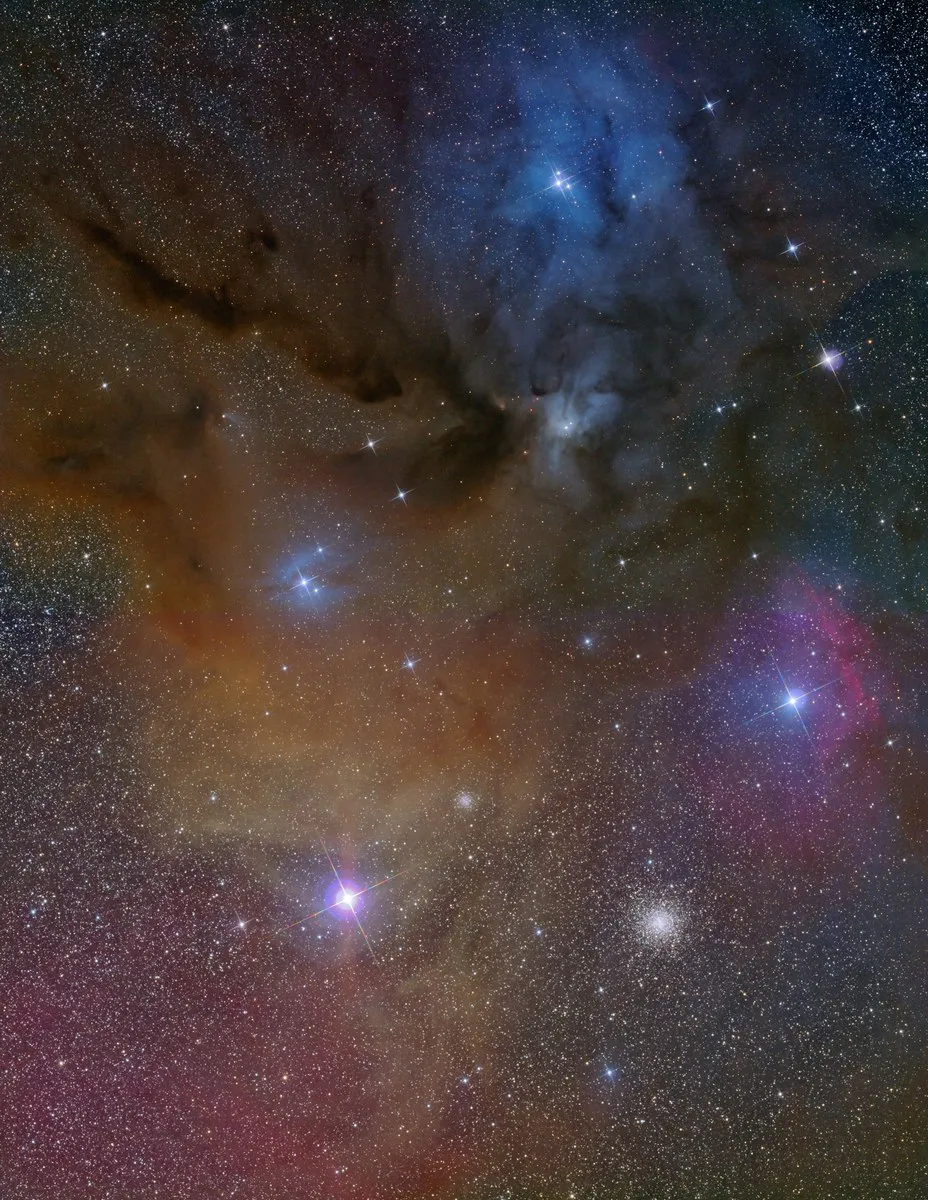
Rho-Ophiuchus Antares Region
Click to Zoom
The Rho-Antares region — a wide-field mosaic in Scorpius, shot from Kitt Peak National Observatory. Credit line: Jay Ballauer, Phil Jones, and Adam Block.
Location: Kitt Peak National Observatory near Tucson, Arizona
Date: June 2, 2005
Seeing: 3/10
Transparency: 9/10
Temperature: 52 degrees F (-20 degrees C on camera)
Scope/Mount: Tak FSQ-106 @ f/5 and Paramount ME
Camera: SBIG STL-11000M astro CCD camera
Exposure Info: Two frame mosaic, RGB image; 20:20:30 RGB for each frame (10 minute subexposures all unbinned), processed with synthetic luminance
Processing Information: Calibration (darks, bias, flats), registration, gradient removal, and RGB channel combine in MaxIm DL 4 (mean combine). LRGB combine, mosaic stitching, cropping, color balance, levels/curves, sharpening, and noise removal in Photoshop CS.
Exposure Notes: String used on the front of the aperture to give the diffraction spikes on the stars. Data was taken by Jay Ballauer, Phil Jones, and Adam Block. Image processing done by Jay Ballauer. Special thanks to Adam Block for hosting Phil and I at the Advanced Observer's Program atop Kitt Peak. Likewise, thanks to the Three Rivers Foundation and Dr. Fred Koch for sponsoring the trip.
- What it is
- The Rho Ophiuchi cloud complex, together with the nearby red supergiant Antares, forms one of the most colorful regions in the sky, straddling the border of Ophiuchus and Scorpius.
- Constellation
- Ophiuchus / Scorpius border
- Distance
- ~460 ly (Rho Oph cloud); ~550 ly (Antares)
- Apparent magnitude
- 1.06 (Antares)
- Angular size
- several degrees (complex)
- Coordinates
- Antares: RA 16h 25m, Dec -23° 27′
This summary was generated by an AI assistant from general astronomical references, not from Jay's own notes on this specific image. Treat every detail above as a starting point for research, not settled fact.