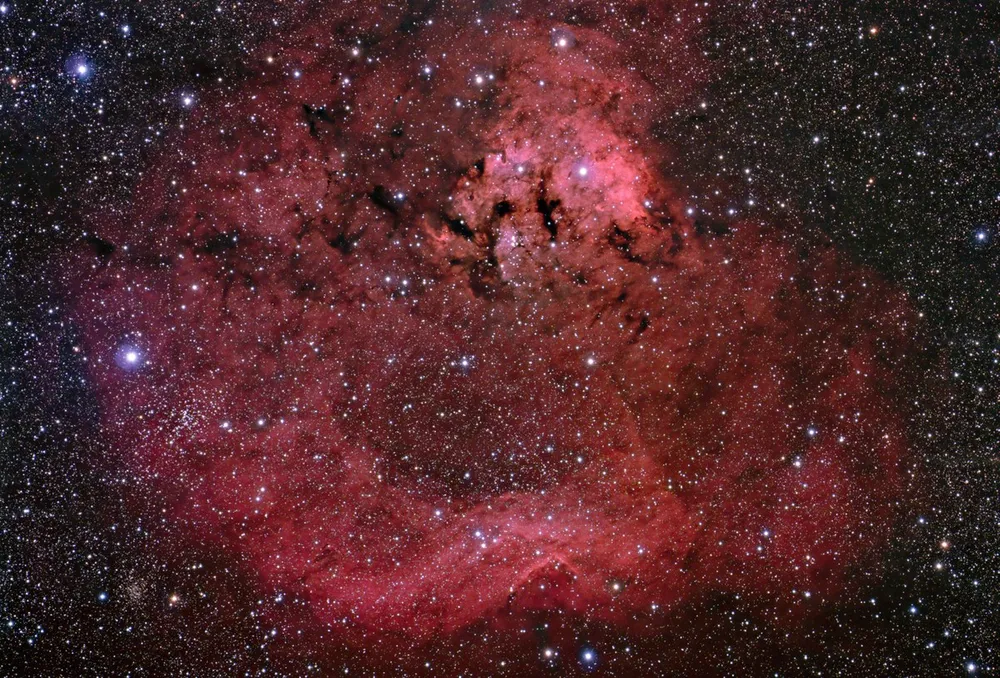
NGC 7822 and Ced 214
Click to Zoom
NGC 7822 and Cederblad 214, in HaRGB.
Location: Okie-Tex Star Party 2006, near Kenton, Oklahoma and Eldorado Star Party 2006 near Eldorado, Texas
Date: September-October, 2006
Seeing: 3/10 on average
Transparency: 8/10 on average
Temperature: -25 degrees C on camera
Scope/Mount: Tak FSQ-106 and Paramount ME
Camera: SBIG STL-11000M astro CCD camera
Filter: 4.5nm Custom Scientific H-alpha filter
Exposure Info: HaRGB image; 160:60:60:60 minutes (20 minute subexposures for Ha and 10 minute subexposures for RGB, all unbinned)
Processing Information: Acquisition with CCDSoft. Calibration (darks/flats), registration, and RGB channel combine in CCDstack (median combine). HaRGB combine and Ha blending, color balance, levels/curves, noise removal/local contrast enhancement/DSO enhancement-star reduction (Noel Carboni's Astronomy Tools) in Photoshop CS.
Exposure Notes: Interesting target. Sub-par seeing conditions. RGB data taken from Okie-Tex as well as 40 minutes of Ha data. The rest taken at Eldorado Star Party. Incidentally, my friend Rockett Crawford calls Ced 214, "the nose." Indeed, looks quite like Karl Malden to me!
- What it is
- NGC 7822 and the associated Cederblad 214 form a large, faint emission nebula and young star-forming region, home to some of the hottest, most massive stars known nearby — a favorite target for narrowband astrophotography.
- Constellation
- Cepheus
- Distance
- ~3,000 light-years
- Apparent magnitude
- ~7 (faint, extended)
- Angular size
- ~60 arcminutes
- Coordinates
- RA 00h 03m, Dec +67° 09′
This summary was generated by an AI assistant from general astronomical references, not from Jay's own notes on this specific image. Treat every detail above as a starting point for research, not settled fact.