NGC 6888 - Crescent Nebula
Click to Zoom
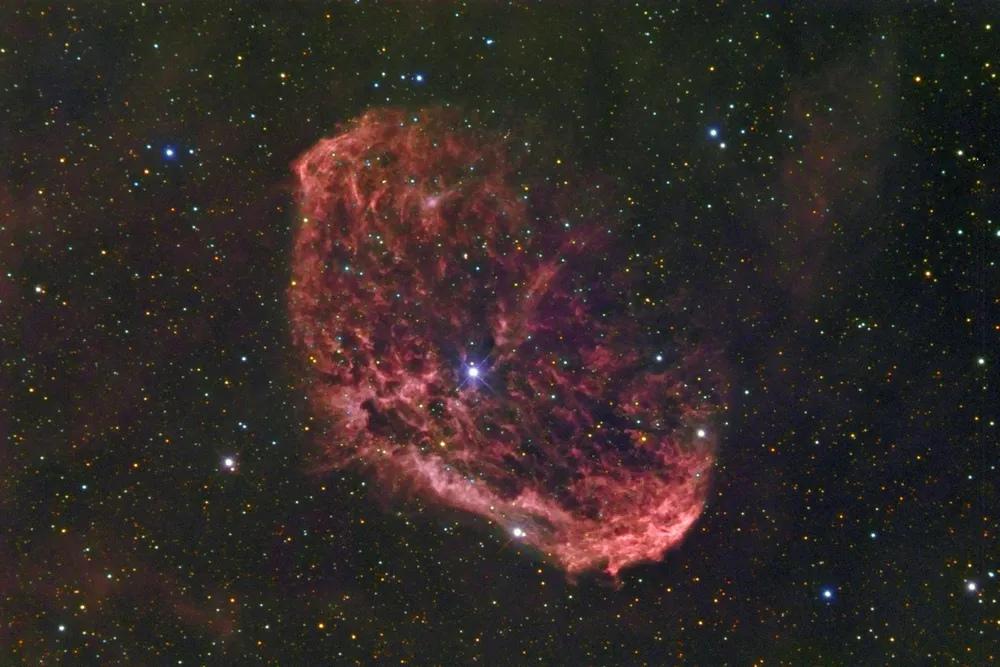
NGC 6888, the Crescent Nebula, in HaRGB.
Location: Ballauer Observatory near Azle, Texas
Date: June 26 & 27, 2005
Seeing: 7/10
Transparency: 3/10
Temperature: 72 degrees F
Scope/Mount: 12.5" RCOS RC and Paramount ME
Camera: SBIG STL-6303e (Ha) and SBIG STL-11000M (RGB) astro CCD cameras
Filter: Custom Scientific 4.5nm Hydrogen-alpha filter
Exposure Info: HaRGB image - 120:80:50:80 minutes (20 minute subexposures for Ha; 10 minute subs for RGB; all unbinned)
Processing Information: Calibration, registration, DDP, and RGB combine in MaxIm DL 4. HaRGB combine, levels/curves, sharpening, and noise removal in Photoshop CS.
Extra Notes: H-alpha data blended 50% with the red channel to improve color saturation. H-alpha data was then used again as luminance.
Another View…
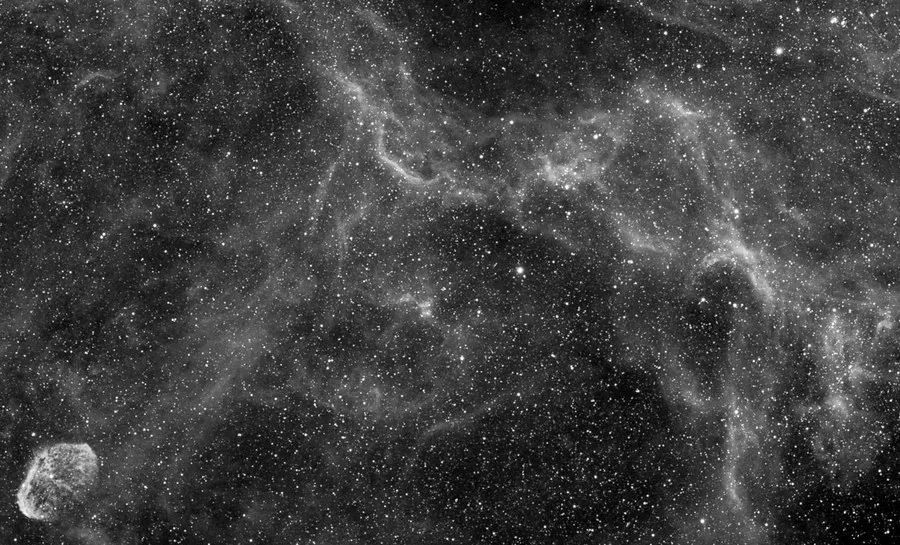
Here is a wide-field shot of the area extending south-east from the Crescent Nebula, NGC 6888, shown in the lower-left of this image. The total exposure is over 3 hours in Hydrogen-alpha light, a method that allows for capturing detail of the hydrogen gases being emitted in this area. It is a region of interesting nebulosity from the Cygnus Milky Way, a southern extension of IC 1318 around Gamma Cygni; however, none of the nebulosity in this image has a designation, at least none that I'm aware of. There are star clusters contained within the dust. Open clusters NGC 6871 and NGC 6883 are included at the right side of the image. NGC 6874 is at the upper left.
Location: The Ballauer Observatory near Azle, Texas
Date: July 11, 2004 and September 8, 2004
Scope/mount: Takahashi FSQ-106 @ f/5 and Tak NJP mount
Camera: SBIG STL-6303E, self-guided
Filter: Custom Scientific 4.5nm Hydrogen Alpha
Exposure Info: Grayscale, Hydrogen-alpha filtered image - 205 minutes (15 min. subexposures unbinned).
Processing Info: Dark frame calibration, flat-fields, registration, and average combine in MaxIm 4.0. Digital-Development in MaxIm. Levels, Curves, selective unsharp mask, and selective gaussian blur in Photoshop CS.
- What it is
- NGC 6888, the Crescent Nebula, is a bubble-shaped emission nebula formed by fast stellar wind from a rare Wolf-Rayet star colliding with material the star shed earlier in its life.
- Constellation
- Cygnus
- Distance
- ~5,000 light-years
- Apparent magnitude
- ~7.4
- Angular size
- ~20 × 10 arcminutes
- Coordinates
- RA 20h 12m, Dec +38° 21′
This summary was generated by an AI assistant from general astronomical references, not from Jay's own notes on this specific image. Treat every detail above as a starting point for research, not settled fact.