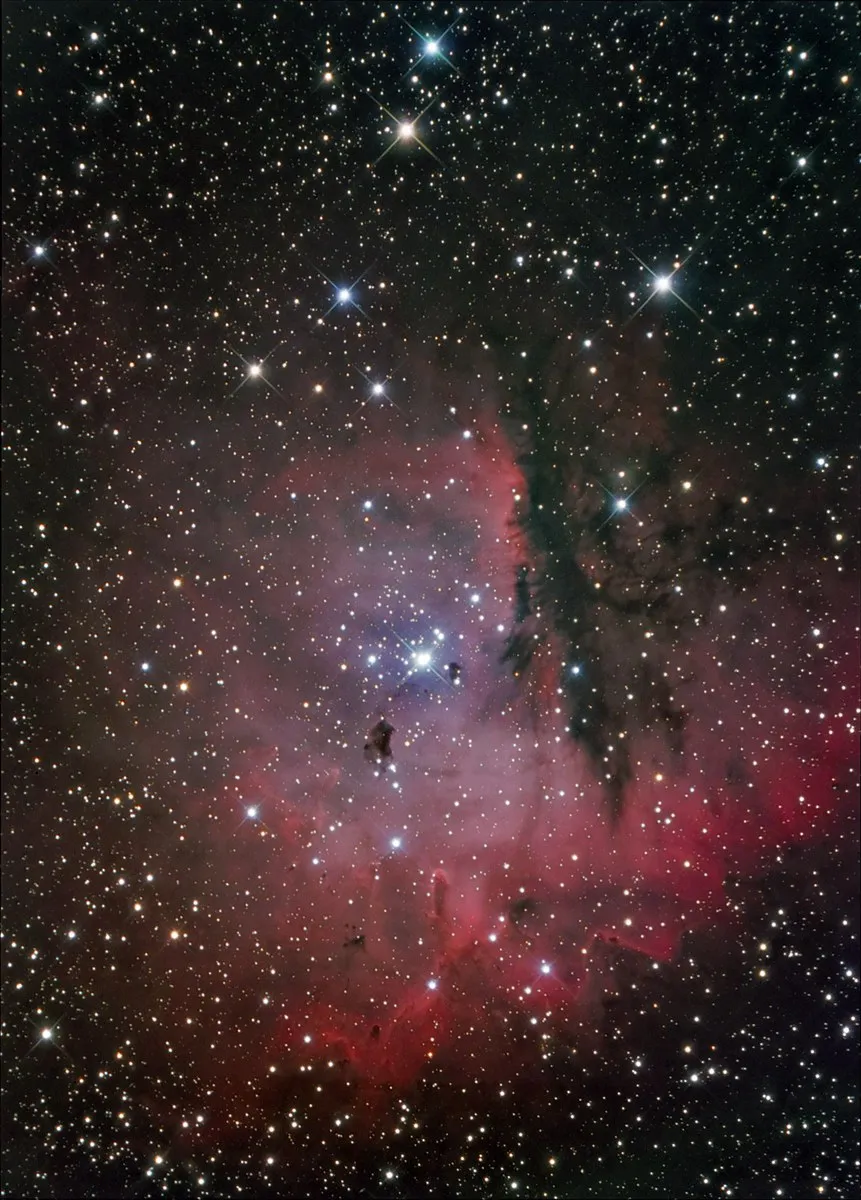
NGC 281 - The Pacman Nebula
Click to Zoom
NGC 281, the Pacman Nebula, in L(Ha+R)GB.
Location: Comanche Springs, 3RF dark sky site near Crowell, TX, and Ballauer Observatory near Azle, TX
Date: October - November, 2005
Seeing: 3/10 on average
Transparency: 6/10 average over 5 nights
Temperature: Chilly (-25 and -20 degrees C on camera)
Scope/Mount: 12.5" RCOS RC @ f/9 and Paramount ME
Camera: SBIG STL-11000M astro CCD camera (LRGB) and SBIG STL-6303e astro CCD camera (Ha)
Exposure Info: L (Ha+R)GB image; 320:60:40:60 minutes with 120 minutes of H-alpha blended with red channel (20 minute subexposures for L, 30 minute subexposures for Ha, and 10 minute subexposures for RGB, color binned)
Processing Information: Acquisition with CCDSoft. Calibration (darks/flats), registration, gradient removal, and RGB channel combine in CCDstack (median combine). LRGB combine and Ha blending, color balance, levels/curves, and noise removal/local contrast enhancement (Noel Carboni's Astronomy Tools) in Photoshop CS.
Exposure Notes: Relatively poor seeing throughout the data set, though the Ha data a little better at ~2.4 FWHM. Used both SBIG cameras for a variety of luminance data. Portions of the Ha data were blended 50% into the red channel using the Lighten blending mode in Photoshop CS.
- What it is
- NGC 281, nicknamed the Pacman Nebula for the dark dust lane that gives it a wedge-shaped "mouth," is an emission nebula and young open cluster.
- Constellation
- Cassiopeia
- Distance
- ~9,200 light-years
- Apparent magnitude
- ~7.4
- Angular size
- ~35 × 30 arcminutes
- Coordinates
- RA 00h 52m 59s, Dec +56° 37′
This summary was generated by an AI assistant from general astronomical references, not from Jay's own notes on this specific image. Treat every detail above as a starting point for research, not settled fact.