NGC 2392 - The Eskimo Nebula
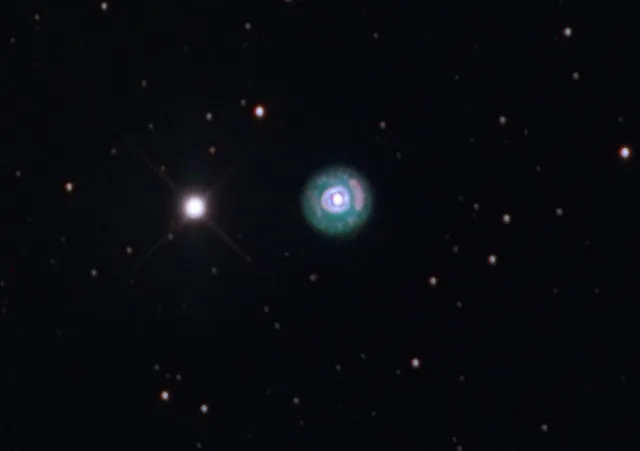
One of the brighter planetary nebulae in the sky, NGC 2392 in Gemini is commonly called the “Eskimo” Nebula, and it’s not difficult to see why. A planetary nebula is the result of a near-dead star slowly shedding itself of its gases. The result is often a bright and colorful ring that encircles the star itself. Of course, the size of such a nebula is rather small, somewhat resembling the size of a planet from our point of view — hence the term “planetary” is an apt classification.
The Eskimo is quite easy to see with even a modest scope and suburban skies. Despite its somewhat dim 9.1 apparent magnitude, like all planetaries it has a very high surface brightness, meaning there is a lot of contrast between the nebula and the sky background. NGC 2392 is a favorite for many observers and can be found close to the twin stars of Gemini, Pollux and Castor.
Location: The Ballauer Observatory near Azle, Texas
Date: February 28, 2005
Transparency: 4.2 mag zenithal
Seeing: 3/10
Temperature: 48 degrees F; camera cooled to -25 degrees C
Scope/Mount: 12.5" RCOS Ritchey-Chretien @ f/9 and Software Bisque Paramount ME mount
Camera: SBIG STL-6303E, self-guided
Exposure Info: LRGB, 30:15:15:30 minutes; 10 minute subexposures luminance and 5 minute subexposures for RGB unbinned.
Processing: Dark/flat frame calibration, registration, gradient removal, hot pixel removal, and Average combine in MaxIm DL 4. Digital Development and RGB combine in MaxIm DL 4. LRGB combine, deblooming, color balance, curves, levels, selective sharpening/blurring/despeckle in Photoshop CS.
Extra Notes: Poor seeing and slight wind affected the exposures. Subexposure times were too long, resulting in an oversaturated central star in the nebula.
- What it is
- NGC 2392, the Eskimo Nebula (also called the Clownface Nebula), is a bipolar double-shell planetary nebula formed by a dying Sun-like star.
- Constellation
- Gemini
- Distance
- ~2,870 - 6,500 light-years (estimates vary widely)
- Apparent magnitude
- 9.1
- Angular size
- ~47 arcseconds
- Coordinates
- RA 07h 29m 11s, Dec +20° 54′ 42″
This summary was generated by an AI assistant from general astronomical references, not from Jay's own notes on this specific image. Treat every detail above as a starting point for research, not settled fact.