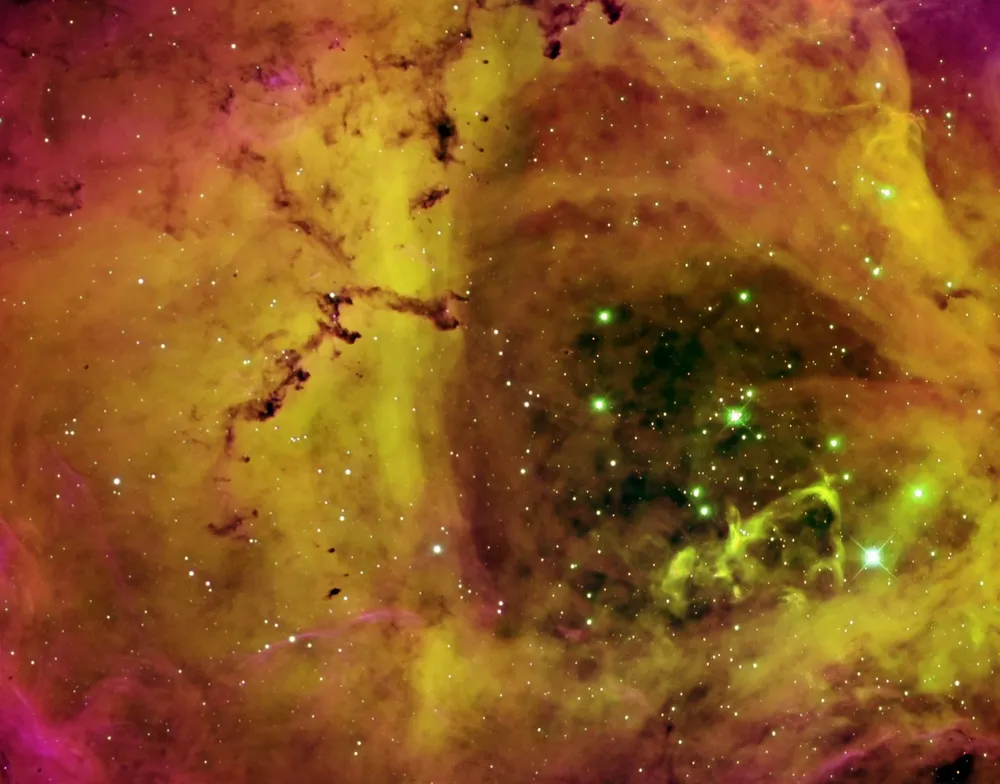
NGC 2244 - The Rosette Nebula (CFHT Colors)
Click to Zoom
NGC 2244, the Rosette Nebula, mapped Ha/OIII/SII to Red/Green/Blue — a reprocess of the same data set as the Hubble-palette version, using the “CFHT” (Canada-France-Hawaii Telescope) color mapping instead.
Location: Ballauer Observatory near Azle, Texas
Date: November 2005 to January 2006
Equipment: 12.5" RCOS RC on a Software Bisque Paramount ME
Camera: SBIG STL-6303e astro CCD camera
Filters: Custom Scientific 4.5nm Ha, OIII, and SII spectral line filters
Exposure Info: Mapped color mosaic, Ha/OIII/SII, 210:60:90 minutes (left side) and 150:90:90 minutes (right side), 20 and 30 minute subexposures unbinned
Processing Information: Calibration, registration, and DDP in CCDStack. Color mapping, cropping, color balance, levels/curves, sharpening, and noise removal (Astronomy Tools/Pro Digital Software) in Photoshop CS.
Exposure Notes: SII data mapped to the red channel, Ha to green, and OIII to blue. Seeing was exceptional for the left side of the mosaic but poor for the right; interestingly, the left side came out much cleaner than the right despite having less exposure time in Ha.
- What it is
- NGC 2244, the Rosette Nebula, is a large emission nebula surrounding a young open star cluster at its center, shown here reprocessed from the same narrowband data using the "CFHT" SII/Ha/OIII → R/G/B color mapping.
- Constellation
- Monoceros
- Distance
- ~5,200 light-years
- Apparent magnitude
- ~9.0 (cluster); nebula surface brightness is much fainter
- Angular size
- ~80 × 60 arcminutes
- Coordinates
- RA 06h 32m, Dec +04° 52′
This summary was generated by an AI assistant from general astronomical references, not from Jay's own notes on this specific image. Treat every detail above as a starting point for research, not settled fact.