The Markarian Chain in Virgo
Click to Zoom and Pan
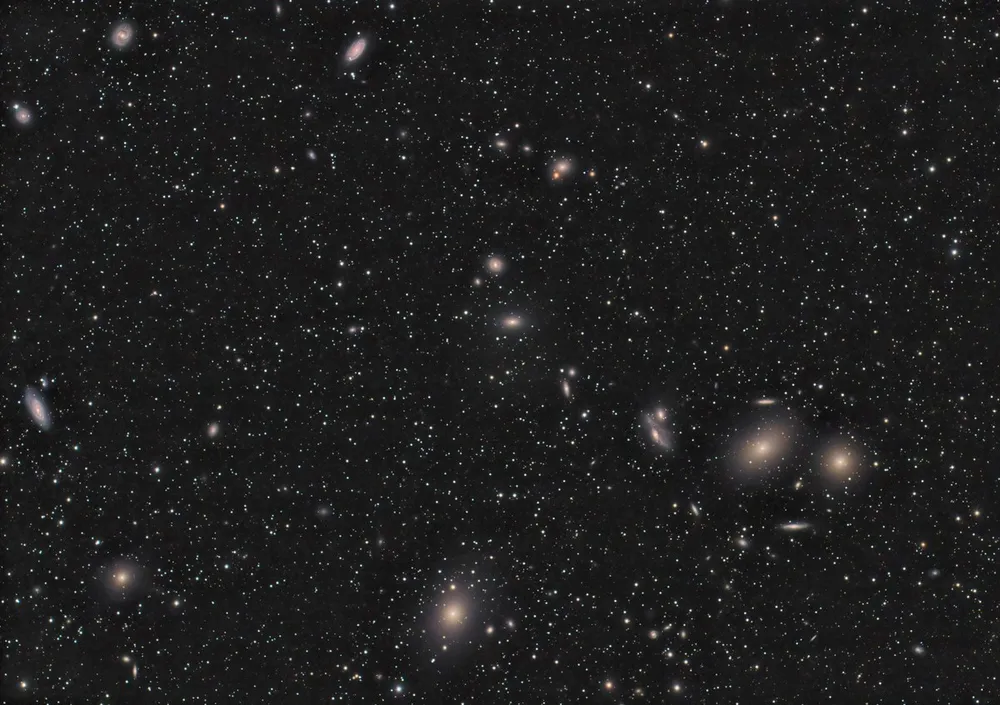
Markarian’s Chain of galaxies in Virgo, in LRGB from the Texas Star Party.
Location: Texas Star Party, 2006, near Ft. Davis, TX
Date: April 29, 2006
Seeing: 3/10
Transparency: 7/10
Scope/Mount: Tak FSQ-106 and Paramount ME
Camera: SBIG STL-11000 astro CCD camera
Exposure Info: LRGB image - 100:20:15:20 minutes (10 minute subexposures unbinned for luminance; 5 minute subexposure binned for RGB)
Processing Information: Acquisition in CCDSoft. Calibration, Registration, DDP, and color combine in CCDStack. Color balance, levels/curves, sharpening, and noise removal (Astronomy Tools/Pro Digital Software) in Photoshop CS.
Exposure Notes: Dark TSP skies, but not quite as transparent as I’ve seen it there. Seeing around 3 to 3.5 arc seconds…good enough for wide field refractors but not for long focal length instruments.
Galaxies in this Image
The Virgo core packs in far more than the chain’s named Messier/NGC members — drag the slider below to reveal 35 catalogued galaxies in the field, brightest first.
M87Galaxymag 8.6M86Galaxymag 8.9M90Galaxymag 9.5M88Galaxymag 9.6M89Galaxymag 9.8NGC 4438Galaxymag 10.2NGC 4473Galaxymag 10.2NGC 4477Galaxymag 10.4M84Galaxymag 10.5NGC 4402Galaxymag 12.6NGC 4435Galaxymag 10.8M91Galaxymag 11.0NGC 4388Galaxymag 11.0NGC 4461Galaxymag 11.2NGC 4459Galaxymag 11.3NGC 4478Galaxymag 11.4NGC 4486AGalaxymag 11.6NGC 4550Galaxymag 11.7NGC 4440Galaxymag 11.7NGC 4571Galaxymag 11.8NGC 4425Galaxymag 11.8NGC 4551Galaxymag 12.0NGC 4458Galaxymag 12.1NGC 4387Galaxymag 12.1NGC 4479Galaxymag 12.4NGC 4531Galaxymag 12.4NGC 4474Galaxymag 12.5VCC 1214GalaxyNGC 4431Galaxymag 12.9NGC 4436Galaxymag 13.0IC 3475Galaxymag 13.3IC 3303Galaxymag 14.2LEDA 41007Galaxymag 15.5LEDA 40598Galaxymag 15.6LEDA 40519Galaxymag 16.0Positions plate-solved via astrometry.net; galaxy identities and apparent magnitudes cross-matched against the SIMBAD catalog (NED’s quick-look magnitude used for the few lacking a comparable SIMBAD V-band measurement). VCC 1214 has no citable magnitude anywhere and is revealed alongside its near-twin NGC 4474 rather than placed by brightness.
Previous Attempts
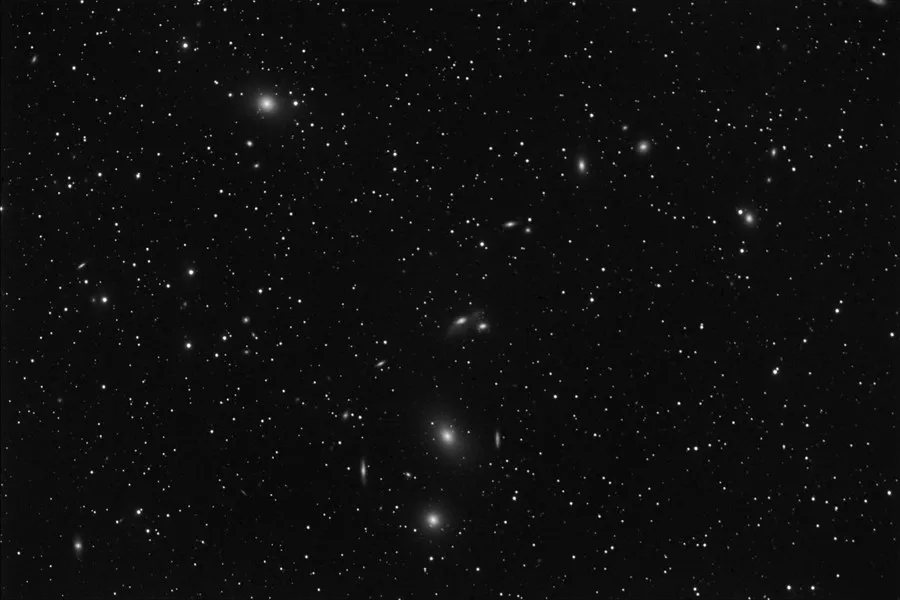
The Markarian Chain
Three prominent Messier galaxies can be seen in this shot, M84, M86, and M87, all of which are massive, elliptical galaxies. The rest of the galaxies are part of a cluster of galaxies in Virgo. Most impressive is the chain of galaxies known as Markarian’s chain. The chain begins at M84, at the bottom of this image, and curving upwards to the right. How many galaxies are here? Perhaps hundreds and thousands. No fewer than thirty are shown in this image. If it’s fuzzy, it’s a galaxy!
Location: Texas Star Party 2004 near Fort Davis, Texas
Seeing: 8/10
Transparency: 9/10
Date and Time: May 16, 2003
Equipment: Tak FSQ-106 @ f/5 on Tak NJP mount
Camera: SBIG STL-6303E NABG with integrated filter wheel
Exposure Info: Grayscale, clear luminance, 6 x 10 minutes
Processing Information: Dark frame calibration, deblooming, registration and Sigma combine in MaxIm DL 4. Digital development in MaxIm DL 4. Levels and curves in Photoshop CS.
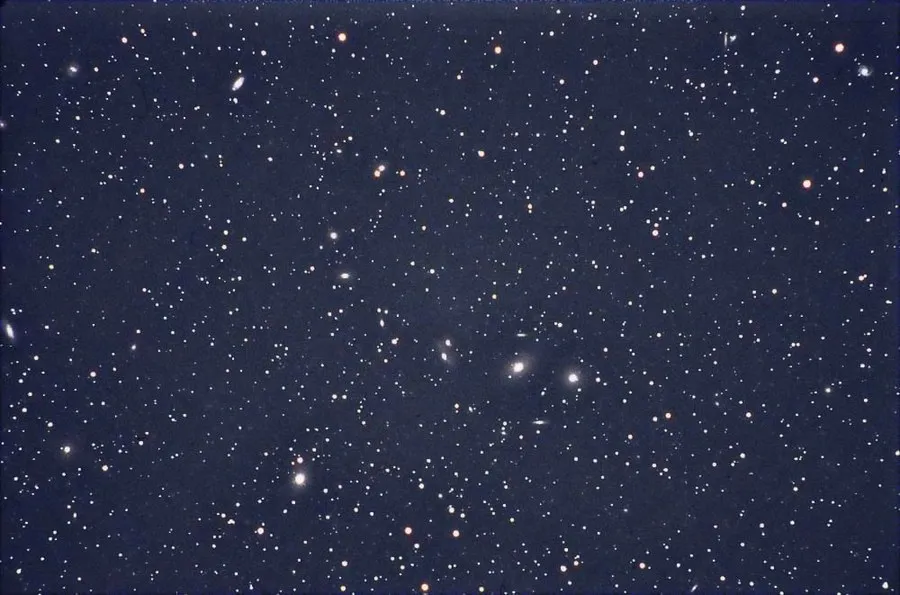
The Virgo Galaxy Cluster
Anything that is not round is a galaxy! I’ve counted no fewer than 20 galaxies in this photo. The Virgo area has the largest concentration of galaxies reachable by amateur telescopes. Shown here is the heart of the Virgo cluster known as the Markarian Chain spanning from M88 at the upper left of the picture to M84 in the center.
Location: Texas Star Party 2003 near Fort Davis, Texas
Seeing: 6/10
Transparency: 9/10
Date and Time: May 2, 2003 @ 11:45 PM CST
Equipment: 420mm @ f4 (300mm Nikkor ED lens with TC14B teleconverter) guided with Meade 208xt
Length: Single 45 minute exposure
Film: Kodak E200 slide film pushed one stop to ISO 320
Processing Information: Image is slightly cropped with a levels adjustment and contrast increase. Slight unsharp mask applied.
Exposure Notes: For a 45 minute exposure at f4, this shot didn’t achieve the depth that I hoped for, especially considering that I gave the film a one stop push. The lack of blue response with the E200 emulsion is obvious here. In particular, the elliptical galaxies M84, M86, and M87 should be much more saturated and detailed.
- What it is
- The Markarian’s Chain is a striking curved line of galaxies — including M84, M86, and several NGC members — at the core of the Virgo Cluster, a rich hunting ground for observing many galaxies in a single field of view.
- Constellation
- Virgo
- Distance
- ~53–60 million light-years
- Apparent magnitude
- 9.1 (M84); 8.9 (M86)
- Angular size
- chain spans ~1.5°
- Coordinates
- M86: RA 12h 27m, Dec +13° 06′
This summary was generated by an AI assistant from general astronomical references, not from Jay’s own notes on this specific image. Treat every detail above as a starting point for research, not settled fact.