M81/82 in Ursa Major
Click to Zoom
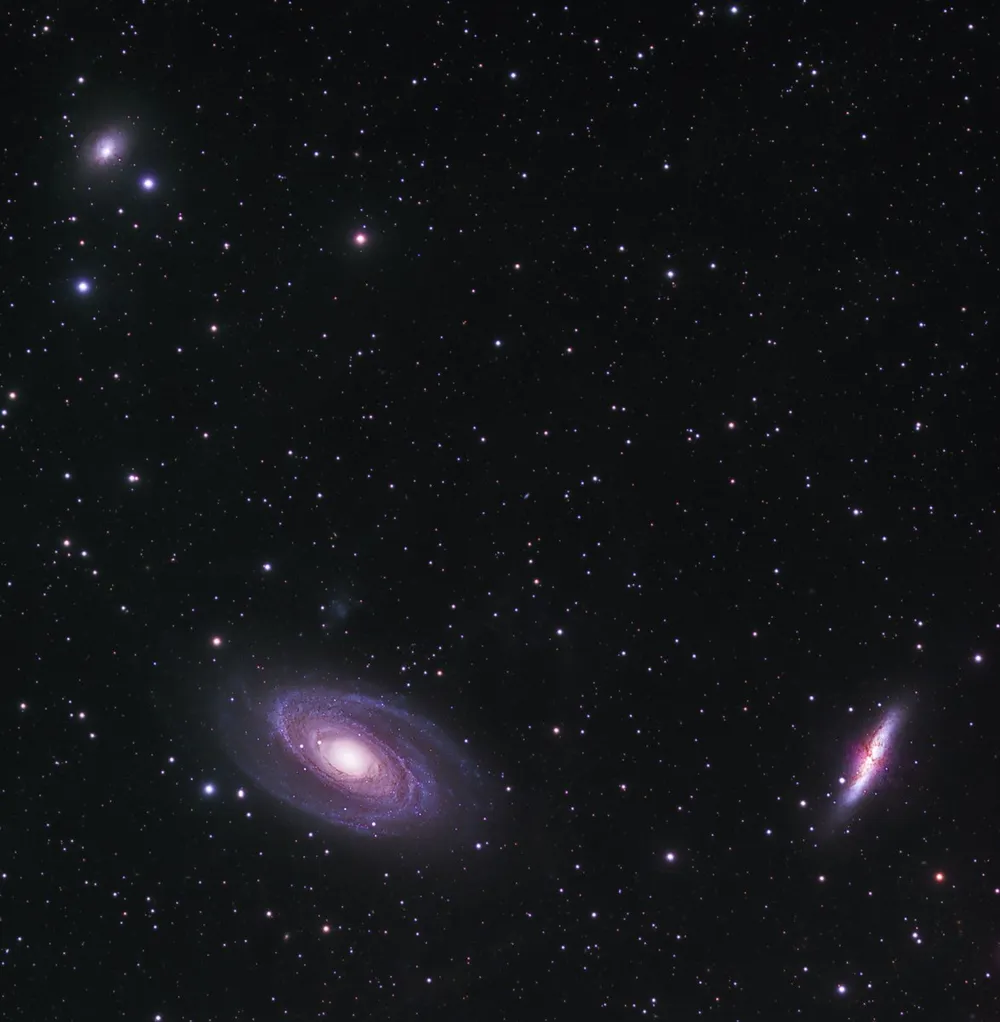
M81, M82, and NGC 3077 — a classic duo plus one — in LRGB. An earlier attempt from 2004 is also on file.
Location: Comanche Springs Astronomy Campus near Crowell, Texas
Date: March to April, 2008
Seeing: 7/10
Transparency: 7/10, windy on second night
Temperature: -20 degrees C on camera
Scope/Mount: Tak TOA-150 (with 67 flattener) on Paramount ME
Camera: SBIG STL-11000M astro CCD camera
Exposure Info: LRGB image; 240:60:60:60 minutes (10 minute subexposures for LRGB)
Processing Information: Acquisition with CCDSoft. Calibration (darks/flats), and registration in CCDstack (median combine). RGB/LRGB combine, color balance, levels/curves, and noise removal (Noel Carboni's Astronomy Tools) in Photoshop CS.
- What it is
- M81, known as Bode's Galaxy, is a grand-design spiral, and M82, the Cigar Galaxy, is a starburst galaxy seen edge-on — the two form a gravitationally interacting pair.
- Constellation
- Ursa Major
- Distance
- ~11.8 million ly (M81); ~12 million ly (M82)
- Apparent magnitude
- 6.9 (M81); 8.4 (M82)
- Angular size
- 26.9 × 14.1′ (M81); 11.2 × 4.3′ (M82)
- Coordinates
- RA 09h 55m, Dec +69°
This summary was generated by an AI assistant from general astronomical references, not from Jay's own notes on this specific image. Treat every detail above as a starting point for research, not settled fact.