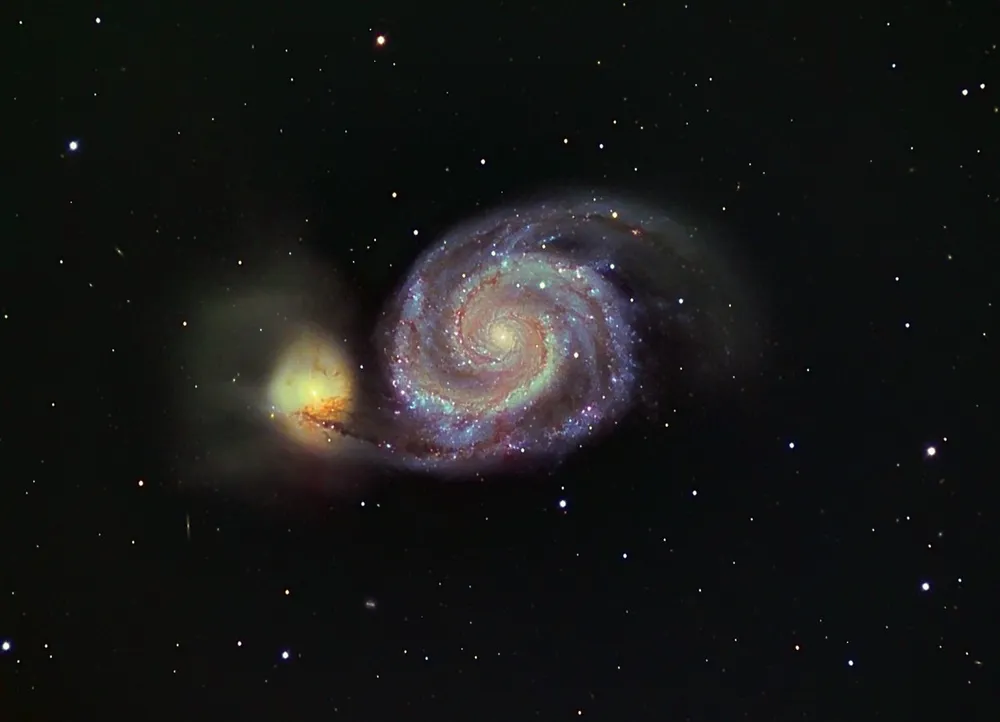
M51 in Canes Venatici
Click to Zoom
M51, the Whirlpool Galaxy, in LLRGB.
Location: Ballauer Observatory near Azle, Texas
Date: April 1, 2005 (luminance) & April 2, 2005 (RGB)
Seeing: 9/10 (luminance) & 2/10 (RGB)
Transparency: 5/10; 4.5 magnitude ZLM
Temperature: 35 degrees F, -25c at the camera (luminance) and 53 degrees F, -23c at the camera (RGB)
Scope/Mount: 12.5" RCOS Ritchey-Chretien (with FFC) and Tak NJP mount
Camera: SBIG STL-6303e astro CCD camera (60 minutes of luminance taken with the SBIG STL-11000M)
Exposure Info: LLRGB image; 160:30:30:55 minutes (10 min subs for luminance; 5 minute subs for RGB binned 2x2)
Processing Information: Dark frame calibration, registration, and DDP in MaxIm DL 4. Lucy-Richardson Deconvolution (2 iterations) in CCDSharp on luminance. RGB and LRGB combine (multiple iterations), cropping, artificial flats, levels/curves, sharpening, and noise removal (despeckle, gaussian blur, dust/scratches) in Photoshop CS. Further noise removal using DSLR Tools v.1.5 Photoshop plug-in (thanks to Noel Carboni).
Notes: A "miracle" image, salvaged from poor information. First time to use the RC with the Tak NJP mount. Plus, I haven't gotten the optical astigmatism (and field curvature) under control with the RC yet!
Good seeing for luminance, though guiding with the NJP mount needs improvement (2.2" to 2.5" FWHM stars after 10 minute subs in 1.2" seeing skies). First 100 minutes of luminance taken with STL-6303, whereupon it frosted over. Remaining 60 minutes of luminance taken with STL-11000, whereupon it TOO frosted over! Fully more than 60% of the total luminance subexposures used for this image showed frosting over more than 30% of the image area, and that doesn't include the other 2 hours of exposures that I couldn't use. Therefore, because I couldn't get an even background through flat fielding, I was going to discard this data. Instead, I cropped the image and applied processing to try to flatten the background artificially - if you've seen a frost-affected image, you know how hard that is! The result was a somewhat respectable luminance image.
The next night, when I took the RGB, I endured some horrible seeing and battled a run-away RA problem with the Tak mount - perhaps a coincidence that daylight savings time occurred during this exposure set? Who knows? Anyway, I wound up with a shortened blue data set. To make matters worse, I couldn't get my camera temperature to the full -25c. Therefore, I had to scale the darks with bias frames - the first time I've ever done that, and I think I did it wrong. So the RGB was horribly noisy, though thank goodness for Sigma combine, generous amounts of blurring, and despeckling in Photoshop. Used several iterations of LLRGB blending to build up/clean up the bad color data.
Needless to say, having brought this image back from the dead, I'm pleased with the results!
- What it is
- M51, the Whirlpool Galaxy, is a grand-design spiral galaxy caught in a gravitational interaction with its smaller companion NGC 5195.
- Constellation
- Canes Venatici
- Distance
- ~23 million light-years
- Apparent magnitude
- 8.4
- Angular size
- ~11.2 × 6.9 arcminutes
- Coordinates
- RA 13h 29m 53s, Dec +47° 11′ 43″
This summary was generated by an AI assistant from general astronomical references, not from Jay's own notes on this specific image. Treat every detail above as a starting point for research, not settled fact.