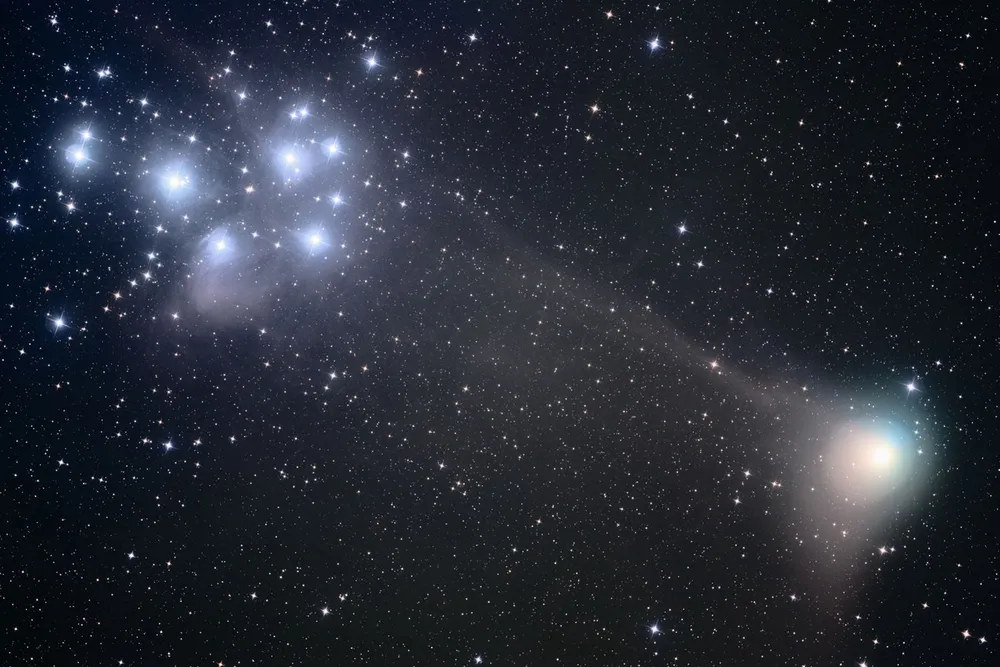
M45 with Comet Machholz
Click to Zoom
Comet Machholz with the Pleiades — Comet C/2004 Q2 passing within two degrees of M45 on January 7, 2005.
Date: January 7, 2005
Location: Copperbreaks State Park near Quanah, Texas
Transparency: 6.2 mag zenithal; heavy dew, frost
Seeing: 4/10
Temperature: 26 degrees F; camera cooled to -25 degrees C
Scope/Mount: Tak FSQ-106 @ f/5 and Tak NJP mount
Camera: SBIG STL-11000, self-guided
Exposure Info: LRGB image. 15:15:9:15 minutes (5 x 3 minutes Luminance; 3 x 5 minutes red; 3 x 3 minutes green; 3 x 5 minutes blue), RGB binned 2x2.
Processing: Dark frame calibration, registration, artificial flats, gradient removal and Sigma Combine in MaxIm DL 4. Digital Development and RGB combine in MaxIm DL 4. Luminance blending, color balance, curves, levels, sharpening and despeckle in Photoshop CS.
- What it is
- Comet Machholz (C/2004 Q2) was a long-period comet discovered in 2004 that became bright enough to see with the naked eye; in early January 2005 it passed strikingly close to the Pleiades (M45) as seen from Earth.
- Constellation
- Taurus (Pleiades' location at the time)
- Distance
- Pleiades ~444 ly; comet distance varied (a temporary solar-system visitor)
- Apparent magnitude
- Pleiades 1.6; comet ~3.5–4 at its brightest
- Angular size
- Pleiades ~110 arcminutes
- Coordinates
- Pleiades: RA 03h 47m, Dec +24° 07′
This summary was generated by an AI assistant from general astronomical references, not from Jay's own notes on this specific image. Treat every detail above as a starting point for research, not settled fact.