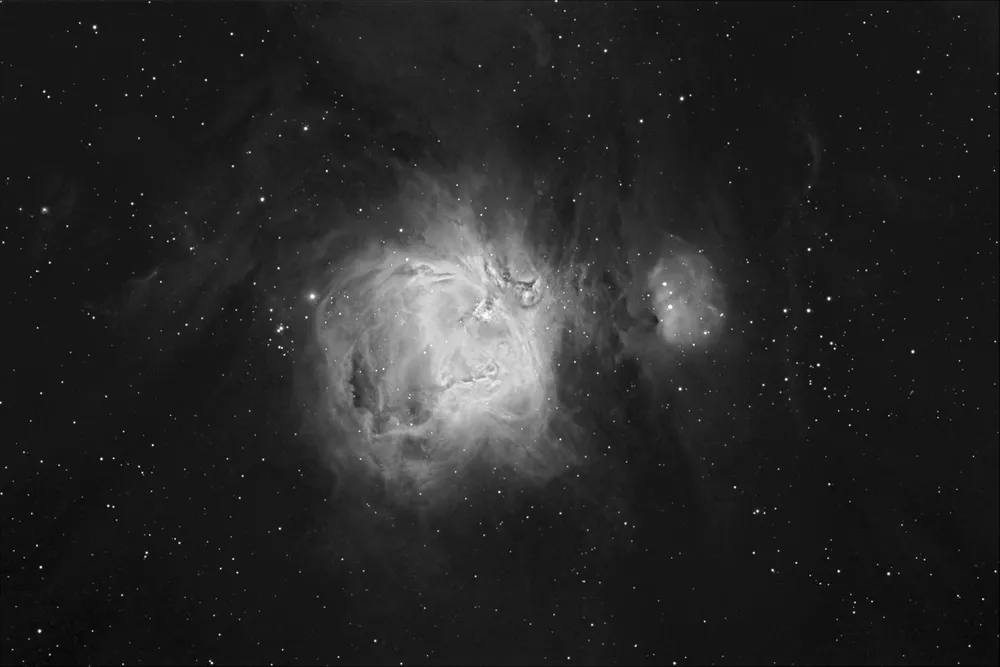
M42 - The Orion Nebula in Hydrogen-Alpha
Click to Zoom
The Great Orion Nebula complex in Hydrogen-Alpha light.
Location: Eldorado Star Party 2004 near San Angelo, Texas
Date: October 15, 2004
Seeing: 6/10
Transparency: 8/10
Equipment: Tak FSQ-106 on Tak NJP mount
Camera: SBIG STL-6303E, self-guided
Filter: Custom Scientific 4.5nm Hydrogen-Alpha spectral line filter
Exposure Info: Grayscale - Ha filtered image - 80 minutes (10 minute sub-exposures) and five 30 second exposures for the central masks.
Processing Info: Darks, deblooming, alignment, and Sigma combine in MaxIm 4.0. Digital Development in MaxIm 4.0. Separate mask from shorter exposures used to replace the burned-out core regions. Masked layers re-leveled and balanced to match in Photoshop CS. Final smoothing and sharpening in Photoshop CS.
- What it is
- M42, the Orion Nebula, is a diffuse emission and reflection nebula and one of the closest large star-forming regions to Earth. It's easily visible to the naked eye as the fuzzy "star" in Orion's sword.
- Constellation
- Orion
- Distance
- ~1,344 light-years
- Apparent magnitude
- ~4.0
- Angular size
- ~65 × 60 arcminutes
- Coordinates
- RA 05h 35m 17s, Dec -05° 23′ 28″
This summary was generated by an AI assistant from general astronomical references, not from Jay's own notes on this specific image. Treat every detail above as a starting point for research, not settled fact.