M31 - The Andromeda Galaxy with M32
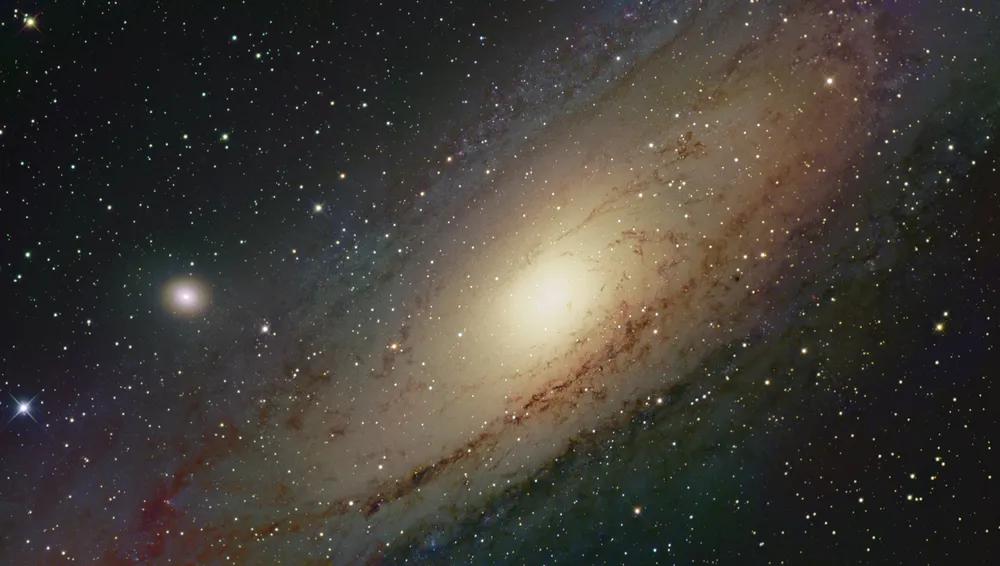
M31 - The Andromeda Galaxy with M32

Click to Zoom

A three-panel mosaic of the Andromeda Galaxy and its companion, M32.  Two earlier attempts at this same object — from 2004 and 2003 — are also on file, if you’re curious how this one evolved.  A much more ambitious eight-panel mosaic from 2019 is the newer, definitive version.

Location: Okie-Tex Star Party, 2005, and Ballauer Observatory near Azle, Texas

Date: October 7, 8, and December 5, 2005

Seeing: 1/10, 10 to 15 mph wind on average

Transparency: 5/10

Temperature: 40 degrees F on average (camera at -25c)

Scope/Mount: 12.5" RCOS RC and Paramount ME

Camera: SBIG STL-11000 astro CCD camera

Exposure Info: LRGB mosaic - 400:105:70:95 minutes over three frames (10 minute subexposures, color binned)

Processing Information: Calibration/registration of individual frames in CCDStack. RGB combine of frames and stitching of master luminance in Photoshop CS. Registration/blending of mosaic, addition of large luminance, color balance, localized color manipulation, levels/curves, sharpening, and cropping in Photoshop CS. Smoothing and local contrast increase in Photoshop with Noel Carboni's Astronomy Tools Plug-in.

About this Image

When the night gives you bad seeing and windy conditions and all you have is a large focal length scope, what do you do? You shoot a mosaic! While this in no way is meant to compete with other high-resolution mosaics you might see, it's a good way to salvage an otherwise poor evening, or two.

Shot entirely at Okie-Tex Star Party except for the blue channel of one of the frames. This was a difficult project to put together, especially since the right-most frame suffered the worst winds, which lowered the S/N significantly and bloated the stars. Color is probably not accurate by any means, as I had to do some localized color correction to get everything to fit together. Still, not too bad of a result.

One of the night sky's grandest features, the Andromeda Galaxy is one of the largest, brightest, and nearest objects outside of our own Milky Way galaxy. With an apparent size of more than six of our full moons, this object fills the eyepiece of just about any telescope and is difficult to fit on most CCD chips. It is an easy naked-eye object in even moderately bright skies, shining at a magnitude of 3.4.

M32, a companion elliptical galaxy, is the round object just left of M31's core. Below M31 is another elliptical galaxy known as M110, shining at magnitude 7.9 — well known for being the last object in the Messier catalog. The dust lanes evident around the core of M31 can be seen with large-aperture scopes in dark skies, as can both of its companion galaxies.

Compared to many of the brighter galaxies, the Andromeda Galaxy shows less detail when observed visually, though nothing is more picturesque.