M27 - The Dumbbell Nebula in "VLT" Colors
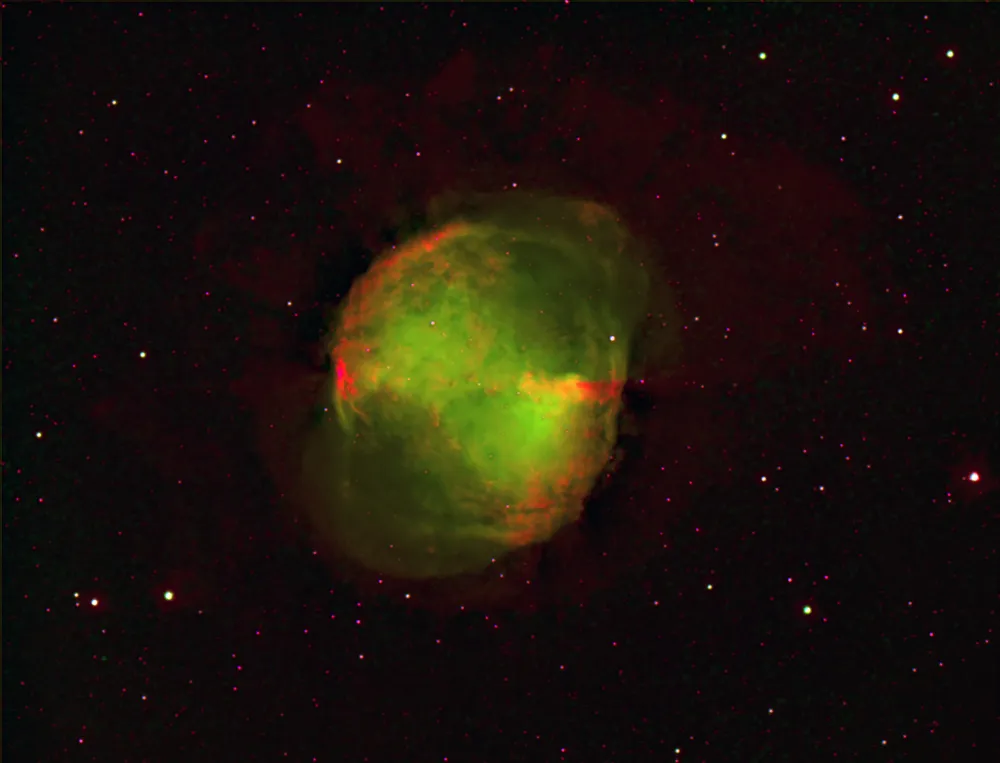
M27, the Dumbbell Nebula, mapped to “VLT” colors — Red = Ha, Green = OIII, Blue = SII (with a hint of Ha to simulate H-beta). A Hubble-color mapping of the same underlying data is also on file.
Location: Ballauer Observatory near Azle, Texas
Date: June 24th and 25th, 2005
Seeing: 9/10
Transparency: 2/10 (shot near full moon phase)
Temperature: 69 to 72 degrees F (camera at -15c)
Scope/Mount: 12.5" RCOS RC and Paramount ME
Camera: SBIG STL-6303e astro CCD camera
Filters: Custom Scientific 4.5nm Ha, OIII, and SII spectral line filters
Exposure Info: Mapped color image - Ha/OIII/SII - 300:80:120 minutes (20 minute subexposures unbinned)
Processing Information: Calibration, registration, hot/cold pixel removal, and DDP in MaxIm DL 4. LR Deconvolution on Ha channel in CCDSharp. Color mapping, cropping, color balance, levels/curves, sharpening, and noise removal in Photoshop CS.
Exposure Notes: This is a re-mapping of the same color data used in the Hubble colors image. The Ha data is mapped to the red channel, OIII to green, and SII to blue. Some H-alpha data (15%) was blended into the blue channel as well to imitate H-beta emissions. Seeing was exceptional, in the 1" arc second neighborhood, but data was taken near a full moon.
About this Image
This is an attempt to take spectral line emission data and use the same techniques as the well-known European Southern Observatory (ESO) image taken back in 1998 on the newly constructed 8.2 meter VLT scope. While this image was taken with much less aperture, the instrumentation is so sophisticated in such scopes that it's rather remarkable! Of course, the ESO image used only 5 minute exposures for each component!
The only difference between the two images, other than the general quality, is that the ESO image used a broadband filter to capture data for the blue channel while this image uses singly ionized Sulfur data for blue (with a hint of Ha data to simulate H-beta gases). Otherwise, Ha is mapped to red and OIII is mapped to green in both images.
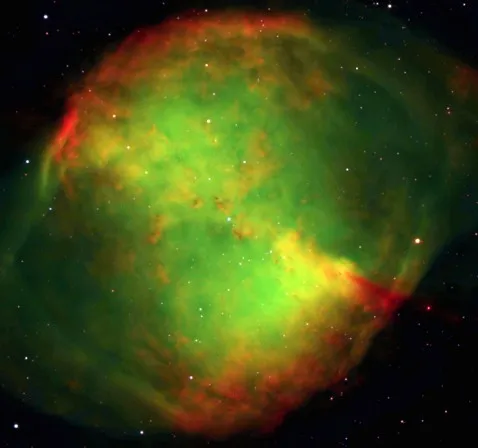
The original 1998 ESO VLT image of M27 that inspired this attempt. Credit: ESO, licensed under CC BY 4.0.
- What it is
- M27, the Dumbbell Nebula, was the first planetary nebula ever discovered, by Charles Messier in 1764, and is one of the brightest planetary nebulae in the sky.
- Constellation
- Vulpecula
- Distance
- ~1,360 light-years
- Apparent magnitude
- 7.5
- Angular size
- ~8 × 5.7 arcminutes
- Coordinates
- RA 19h 59m 36s, Dec +22° 43′ 16″
This summary was generated by an AI assistant from general astronomical references, not from Jay's own notes on this specific image. Treat every detail above as a starting point for research, not settled fact.