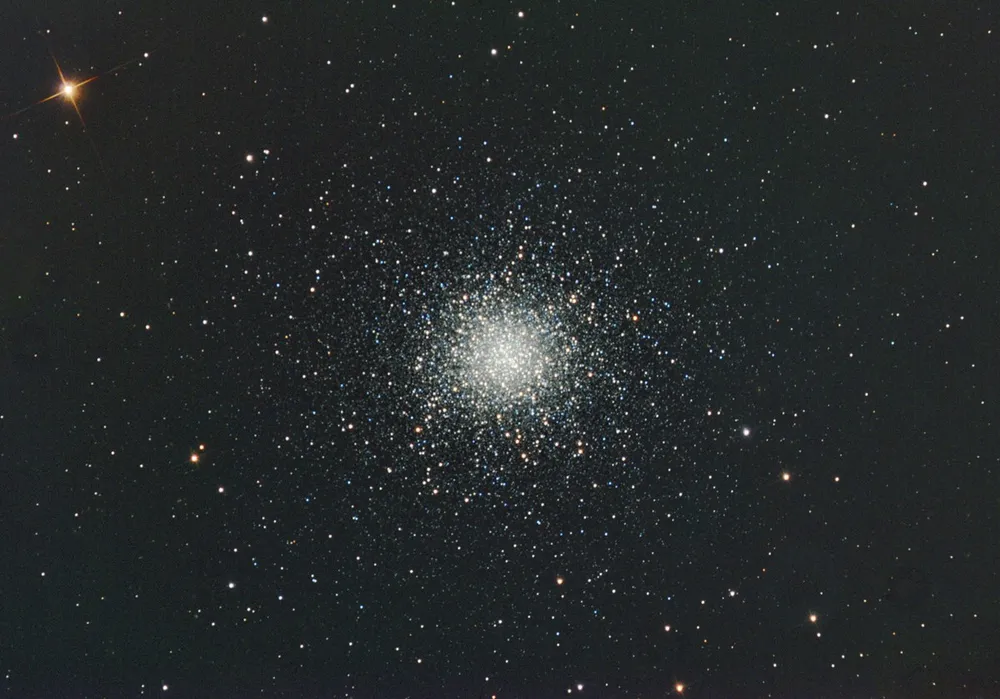
M13 - The Hercules Cluster
Click to Zoom
M13, the Great Hercules Cluster, in LRGB with synthetic luminance.
Location: Comanche Springs, 3RF dark sky site near Crowell, Texas
Date: May 19, 2005
Seeing: 5/10
Transparency: 8/10 (mag. 3.5 skies, 11 day moon)
Temperature: 62 degrees F (-15 degrees C on camera)
Scope/Mount: 12.5" RCOS RC @ f/9 and Paramount ME
Camera: SBIG STL-11000M astro CCD camera
Exposure Info: LRGB image; 45:30:45 RGB with synthetic luminance (5 minute subexposures all unbinned)
Processing Information: Calibration (darks/flats), registration, gradient removal, DDP, and RGB channel combine in MaxIm DL 4 (Sigma median). LRGB combine, cropping, color balance, levels/curves, sharpening, and noise removal (despeckle and gaussian blur) in Photoshop CS.
Exposure Notes: I normally don't image with the moon so bright, but bad weather made me desperate! Still, such an object doesn't require very dark skies, and the magic of image processing really helps to even the background caused by the bright moon. It should be noted that the RC still isn't optimally collimated and aligned yet.
- What it is
- M13, the Great Globular Cluster in Hercules, is one of the brightest globular clusters visible from the Northern Hemisphere, containing several hundred thousand stars packed into a compact sphere.
- Constellation
- Hercules
- Distance
- ~22,200 light-years
- Apparent magnitude
- 5.8
- Angular size
- ~20 arcminutes
- Coordinates
- RA 16h 41m 41s, Dec +36° 27′ 37″
This summary was generated by an AI assistant from general astronomical references, not from Jay's own notes on this specific image. Treat every detail above as a starting point for research, not settled fact.