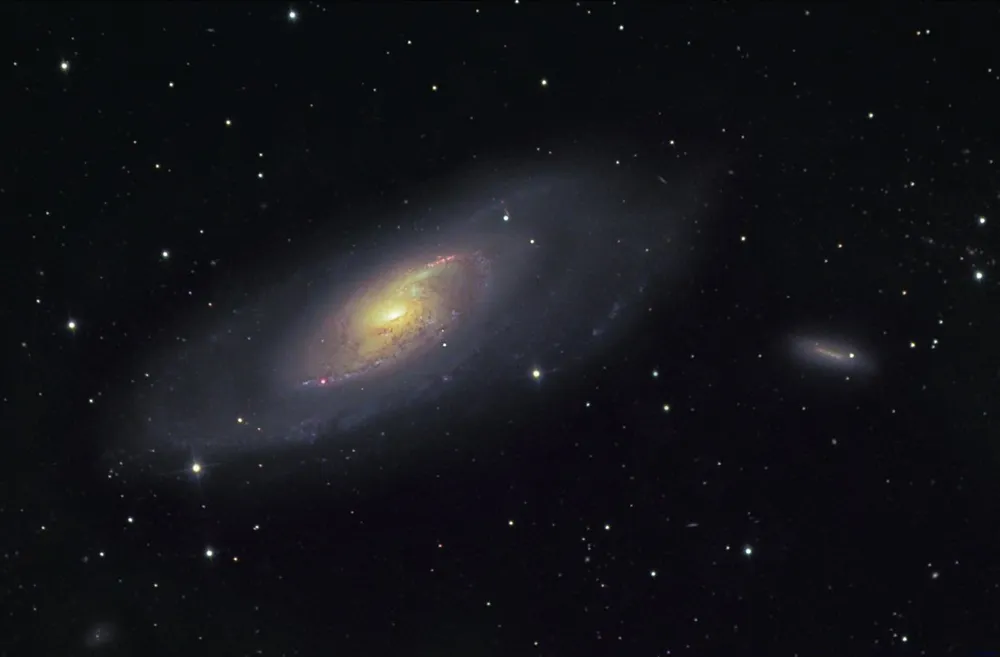
M106 in Canes Venatici
Click to Zoom
A first-light LLRGB image of M106, taken the first night with a new 12.5” RCOS Ritchey-Chretien and Paramount ME.
Location: The Ballauer Observatory near Azle, Texas
Date: February 13, 2005
Transparency: 4.5 mag zenithal
Seeing: 8/10, 1.4" FWHM
Temperature: 45 degrees F, camera cooled to -30 degrees C
Scope/Mount: 12.5" RCOS RC with field flattener and Paramount ME mount
Camera: SBIG STL-6303E, self-guided
Filters: Standard SBIG, clear filter used for luminance
Exposure Info: LLRGB image, 160:30:30:40 minutes - 10 minute subexposures L unbinned and 5 minute subexposures RGB binned 2x2
Processing: Dark frame calibration, flat fields, registration, and Sigma Combine in MaxIm DL 4. Digital Development and RGB combine in MaxIm DL 4. Final LRGB and LLRGB combining, deblooming, gradient removal, color balance, curves, levels, selective sharpening/blurring/despeckle in Photoshop CS.
Extra Notes: This is a first-light, first-night image with the new 12.5" RCOS Ritchey-Chretien scope and Paramount ME. The scope was slightly out of calibration and demonstrated some astigmatism despite the use of the field flattener. Of course, this will soon be corrected.
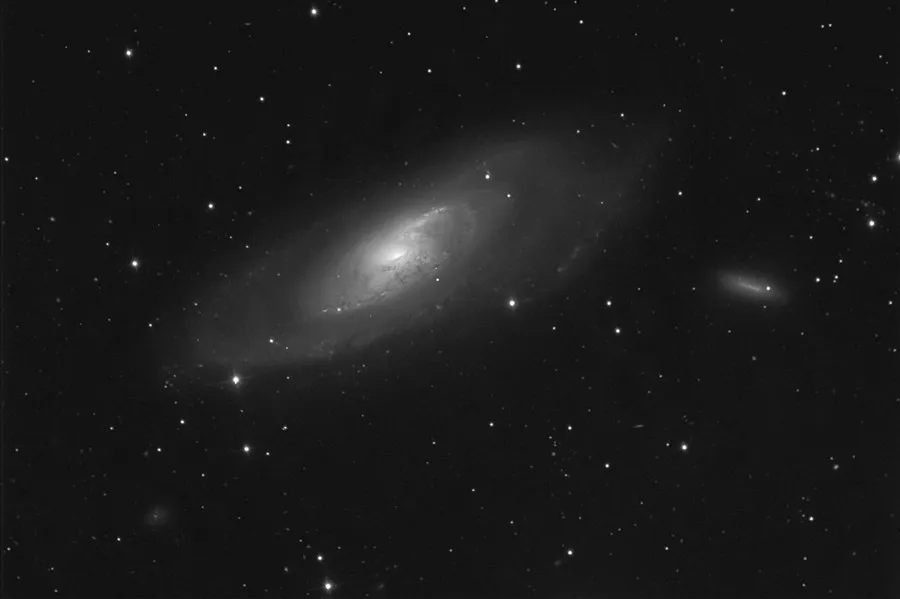
M106 in grayscale, used for luminance in the image above
- What it is
- M106 is an intermediate spiral galaxy with an active (Seyfert II) nucleus.
- Constellation
- Canes Venatici
- Distance
- ~23.5 million light-years
- Apparent magnitude
- 8.4
- Angular size
- ~18.6 × 7.2 arcminutes
- Coordinates
- RA 12h 18m 58s, Dec +47° 18′
This summary was generated by an AI assistant from general astronomical references, not from Jay's own notes on this specific image. Treat every detail above as a starting point for research, not settled fact.