M101 - The Pinwheel Galaxy in Ursa Major
Click to Zoom
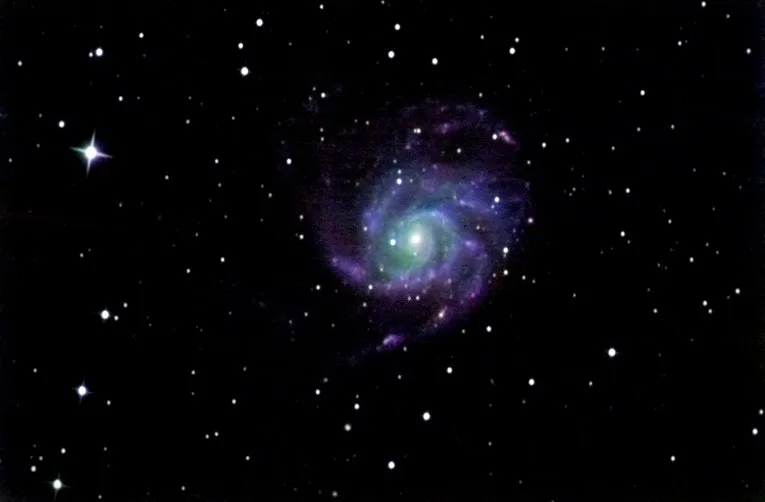
M101, the Pinwheel Galaxy, in LRGB.
Location: Ballauer Observatory in Azle, Texas
Seeing: 8/10 (1.4 FWHM)
Transparency: 4/10
Date and Time: December 29, 2003 @ 11:00PM
Equipment: Tak FSQ-106 @ f/5, and Celestron CGE mount
Camera: SBIG ST-7E with CFW-8a color filter wheel, standard SBIG filters
Exposure Info: LRGB image (L = 5 x 10 minutes, R = 3 x 5 minutes, G = 3 x 5 minutes, B = 5 x 5 minutes) all binned 1x1
Processing Information: Dark frames, gradient removal, registration, Sigma combine and DDP in MaxIm 3.0. Levels, Curves, Gaussian Blur and Unsharp Mask in Photoshop 7.
Exposure Notes: Composite images were taken low in the sky in too much light pollution. Although this shot has 105 minutes of total exposure time, the size of the galaxy should fill the frame from top to bottom. Need much more exposure time in like conditions.
- What it is
- M101 is more commonly cataloged as the Pinwheel Galaxy (the name "Whirlpool" is usually reserved for the similarly-shaped M51). It is a grand-design face-on spiral.
- Constellation
- Ursa Major
- Distance
- ~21 million light-years
- Apparent magnitude
- 7.9
- Angular size
- ~28.8 × 26.9 arcminutes
- Coordinates
- RA 14h 03m 13s, Dec +54° 20′ 56″
This summary was generated by an AI assistant from general astronomical references, not from Jay's own notes on this specific image. Treat every detail above as a starting point for research, not settled fact.