The Iris Nebula
Click to Zoom
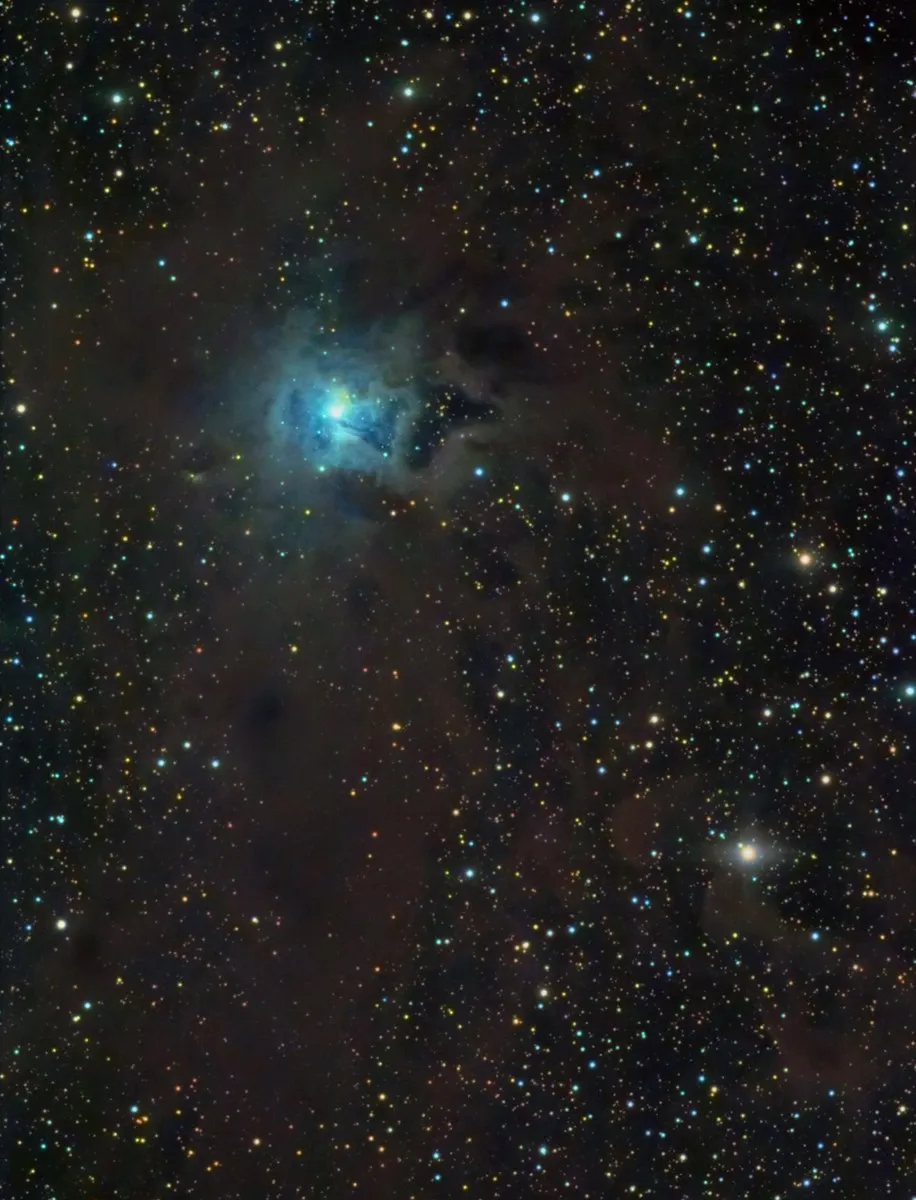
NGC 7023, the Iris Nebula, in LRGB, imaged with a 6” refractor at the Texas Star Party.
Location: Texas Star Party 2008, near Ft. Davis, Texas
Date: June 4-5, 2008
Seeing: 5/10 on average
Transparency: 9.5/10 on average
Temperature: -15 and -20 degrees C on camera
Scope/Mount: Tak TOA-150 and Astrophysics AP900
Camera: SBIG STL-6303e astro CCD camera
Guiding: STL external guidehead through Tak FSQ-106
Exposure Info: LRGB image; 160:70:20:30 minutes (5 minute subexposures for L and RGB, all unbinned)
Processing Information: Acquisition with CCDSoft. Calibration (darks/flats), registration, and RGB channel combine in CCDStack (median combine). LRGB combine, color balance, saturation, levels/curves, and noise removal/local contrast enhancement (Noel Carboni's Astronomy Tools) in Photoshop CS.
Exposure Notes: Tough target. Hard to get enough exposure time. Green and Blue color data was a little thin, but this is where the LRGB technique really shines. The separate luminance fills in the gaps for the weaker color channel data once the luminance is layered multiple times. Earlier iterations utilize heavy noise reduction and blurring in the weaker color channels while allowing the luminance data to sort itself into the appropriate color locations.
- What it is
- The Iris Nebula (NGC 7023) is a blue reflection nebula surrounding a young star.
- Constellation
- Cepheus
- Distance
- ~1,300 light-years
- Apparent magnitude
- 6.8
- Angular size
- ~18 × 18 arcminutes
- Coordinates
- RA 21h 01m, Dec +68° 10′
This summary was generated by an AI assistant from general astronomical references, not from Jay's own notes on this specific image. Treat every detail above as a starting point for research, not settled fact.