IC 405/410 in Capella
Click to Zoom
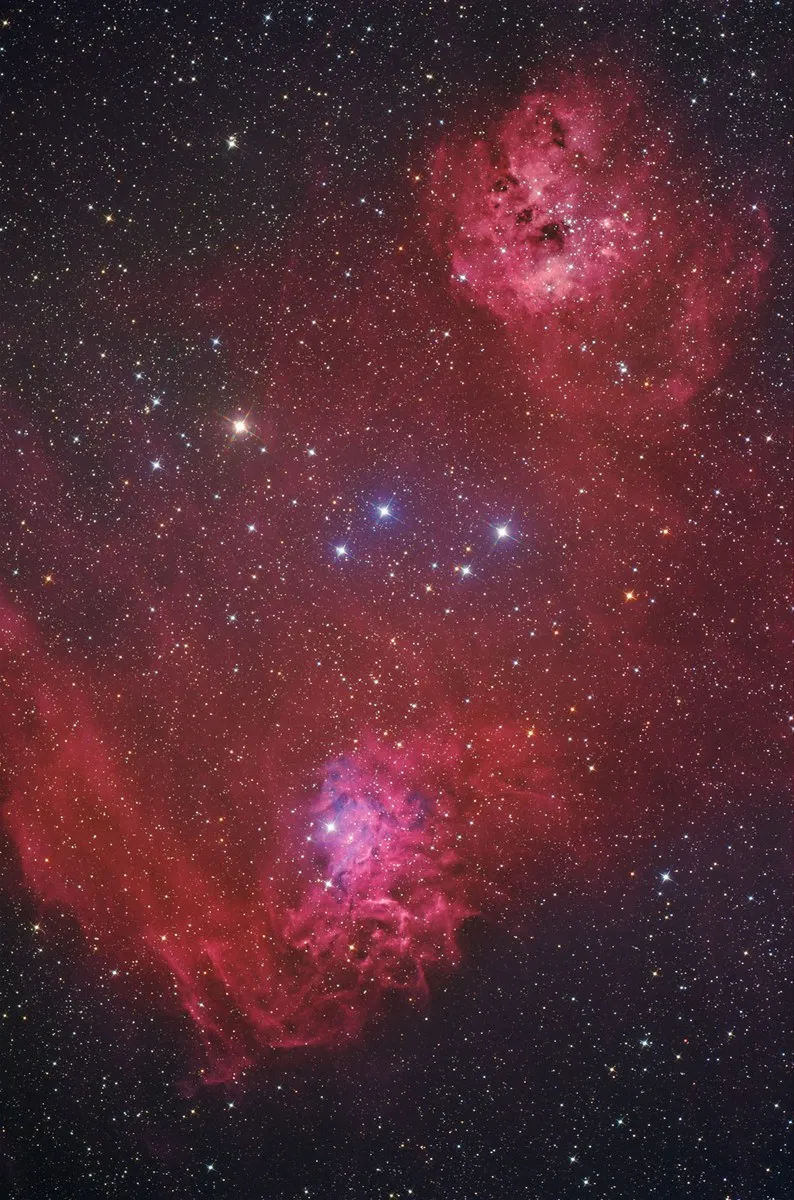
The Flaming Star region — IC 405 and IC 410, a pair of emission nebulae near Capella in Auriga, imaged in Ha(Ha+R)GB.
Date: December 9, 2004 (Ha info) and December 11, 2004 (color info)
Location: The Ballauer Observatory near Azle, Texas (Ha info) and Comanche Springs near Crowell, Texas (color info)
Transparency: 5.2 mag zenithal (Ballauer Observatory) and 6.8 mag zenithal (Comanche Springs)
Seeing: 2/10 (Ballauer Observatory) and 5/10 (Comanche Springs)
Temperature: 55 degrees F (Ballauer Observatory) and 35 degrees F (Comanche Springs); camera cooled to -25 degrees C
Scope/Mount: Tak FSQ-106 @ f/5 and Tak NJP mount
Camera: SBIG STL-6303E (Ha info) and SBIG STL-11000 (color info), self-guided
Exposure Info: Ha(Ha+R)GB, 135:60:60:65 minutes; 15 minute individual exposures for Ha and 5 minute exposures for RGB; all unbinned.
Processing: Dark frame calibration, deblooming, registration, artificial flats, gradient removal and Sigma Combine in MaxIm DL 4. Digital Development and RGB combine in MaxIm DL 4. Ha blending, color balance, curves, levels, selective sharpening/blurring/despeckle in Photoshop CS.
Extra Notes: "First light" image taken with the new SBIG STL-11000 camera, supplied by 3RF. Ha info blended into red at 50% using Screen blending mode. Ha info then used again as luminance at 33%. A string taped to the end of the aperture to create the diffraction spikes.
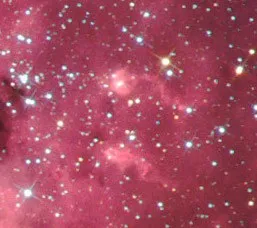
IC 410 features some neat details, like these little tadpoles…or is it cosmic sperm? Hmmm…
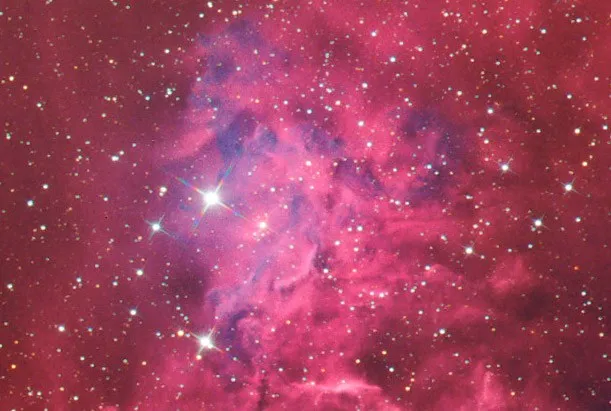
The Flaming Star shown at full resolution of the camera
- What it is
- IC 405, the Flaming Star Nebula, and IC 410 are neighboring emission/reflection nebulae near the bright star Capella; IC 410 hosts the open cluster NGC 1893 and the well-known "tadpole" globules.
- Constellation
- Auriga
- Distance
- ~1,500 ly (IC 405); ~12,000 ly (IC 410)
- Apparent magnitude
- ~6.0 (IC 405); ~7.5 (IC 410)
- Angular size
- ~37 × 19′ (IC 405); ~40 × 30′ (IC 410)
- Coordinates
- near Capella: RA 05h 16m, Dec +34° 16′
This summary was generated by an AI assistant from general astronomical references, not from Jay's own notes on this specific image. Treat every detail above as a starting point for research, not settled fact.