IC 1396 in Cepheus
Click to Zoom
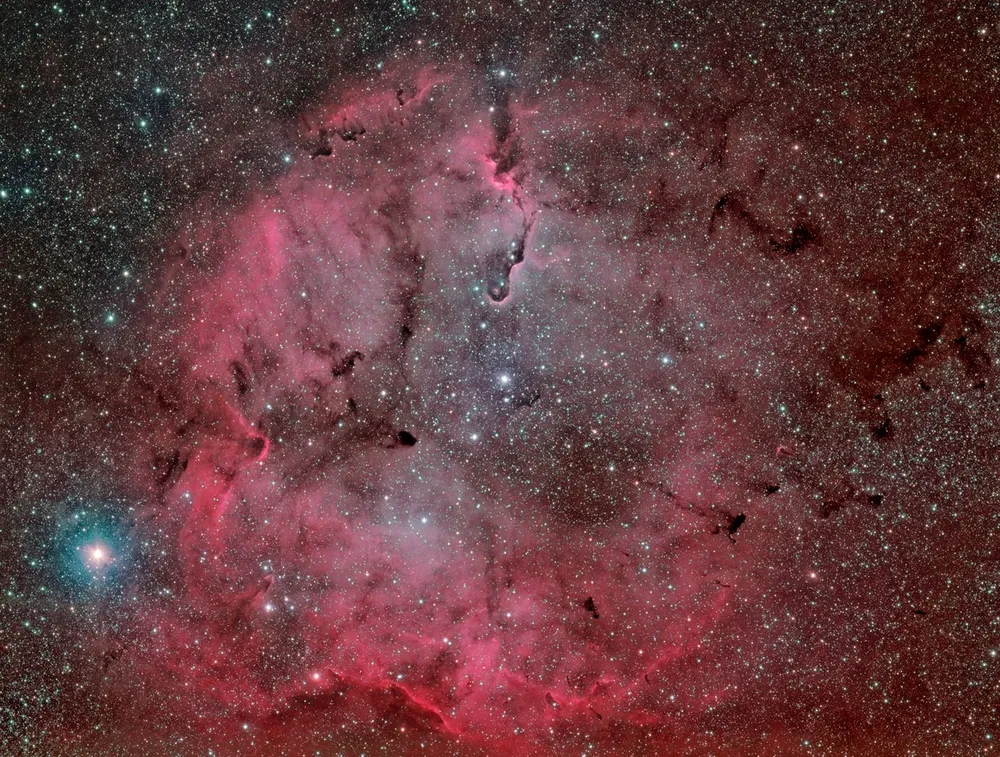
IC 1396, the emission nebula complex in Cepheus, with vdb 142, in Ha+LRGB.
Location: Okie-Tex Star Party, Kenton, OK
Date: September 18-19, 2006
Seeing: 3/10
Transparency: 9/10
Temperature: -25 degrees C on camera
Scope/Mount: Tak FSQ-106 @ f/5 on Paramount ME
Camera: SBIG STL-11000M astro CCD camera
Filter: Custom Scientific 4.5 nm H-alpha filter
Exposure Info: Ha+LRGB image; 150:40:30:30 minutes with 60 minutes of clear luminance data (10 minute subexposures for LRGB, 30 minute subexposures for Ha)
Processing Information: Acquisition with CCDSoft. Calibration (darks/flats), and registration in CCDstack (median combine). LRGB combine and Ha blending, color balance, levels/curves, and noise removal/local contrast enhancement/star halo reduction (Noel Carboni's Astronomy Tools) in Photoshop CS.
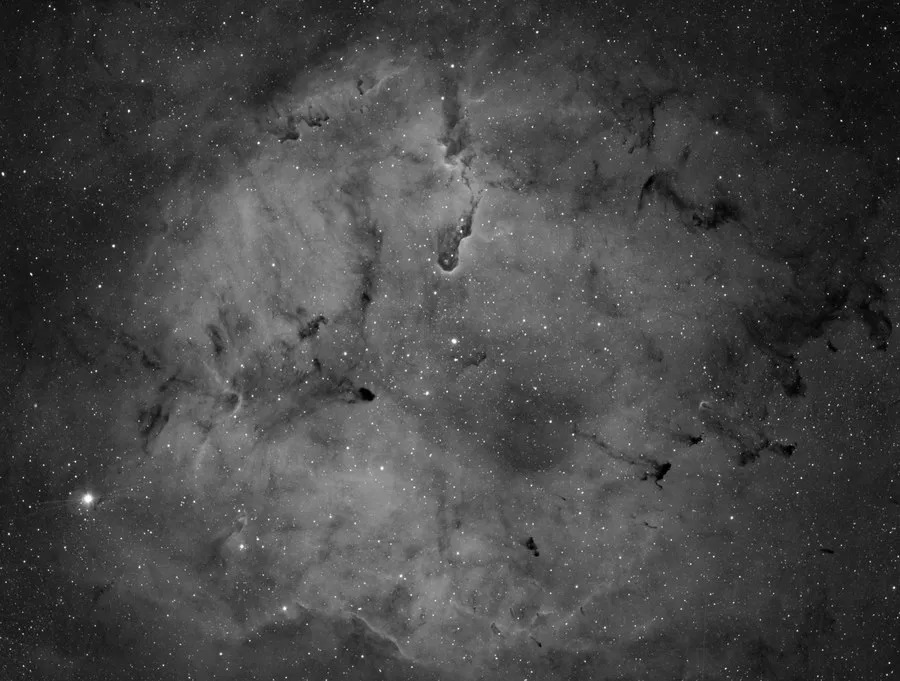
Hydrogen-Alpha data used for the image above (150 minutes)
Previous Images
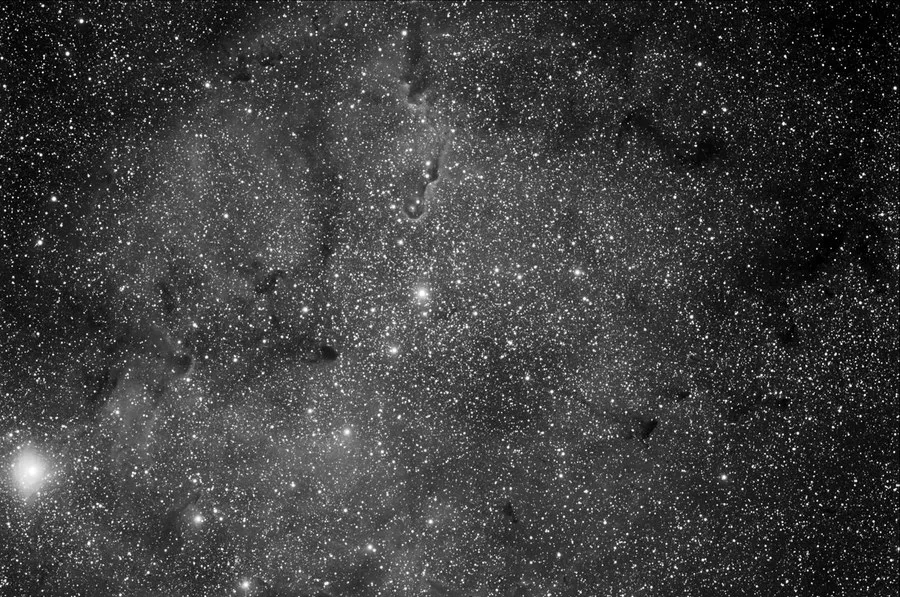
Location: Texas Star Party 2004 near Fort Davis, Texas
Seeing: 6/10
Transparency: 8/10
Date and Time: May 21, 2003
Scope/Mount: Tak FSQ-106 on Tak NJP mount
Exposure information: Grayscale, clear luminance (7 x 10 minutes)
Camera: SBIG STL-6303E with integrated filter wheel
Processing Information: Dark calibration, deblooming, alignment, and sigma combine in MaxIm DL 4. Digital Development in MaxIm 4. Levels and Curves in Photoshop CS.
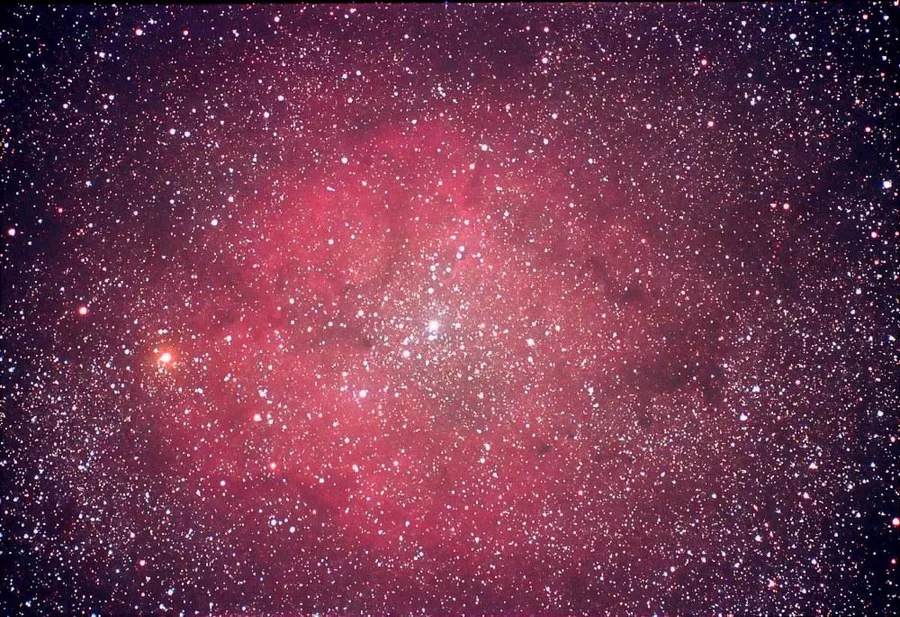
Location: Texas Star Party 2003 near Fort Davis, Texas
Seeing: 6/10
Transparency: 8/10
Date and Time: May 3, 2003 @ 3:35 AM CST
Equipment: 420mm @ f4 (300mm Nikkor ED lens with TC14B teleconverter) guided with Meade 208xt
Length: A single 45 minute exposure
Film: Kodak E200 slide film with one stop push to ISO 320
Processing Information: Image is slightly cropped with a levels adjustment and contrast/saturation increase. Slight unsharp mask applied.
Exposure Notes: I shot this object a bit low on the horizon so some atmospheric discoloration occurred. I managed to process much of it out but some color shift remains. Still, a very pleasing shot!
- What it is
- IC 1396 is an enormous, faint emission nebula and open cluster best known for the dense dark globule within it called the Elephant's Trunk. Its low surface brightness makes it a challenging target that photographs far better than it observes visually.
- Constellation
- Cepheus
- Distance
- ~2,400 light-years
- Apparent magnitude
- N/A — very low surface brightness
- Angular size
- ~170 arcminutes (nearly 3°)
- Coordinates
- RA 21h 39m, Dec +57° 30′
This summary was generated by an AI assistant from general astronomical references, not from Jay's own notes on this specific image. Treat every detail above as a starting point for research, not settled fact.