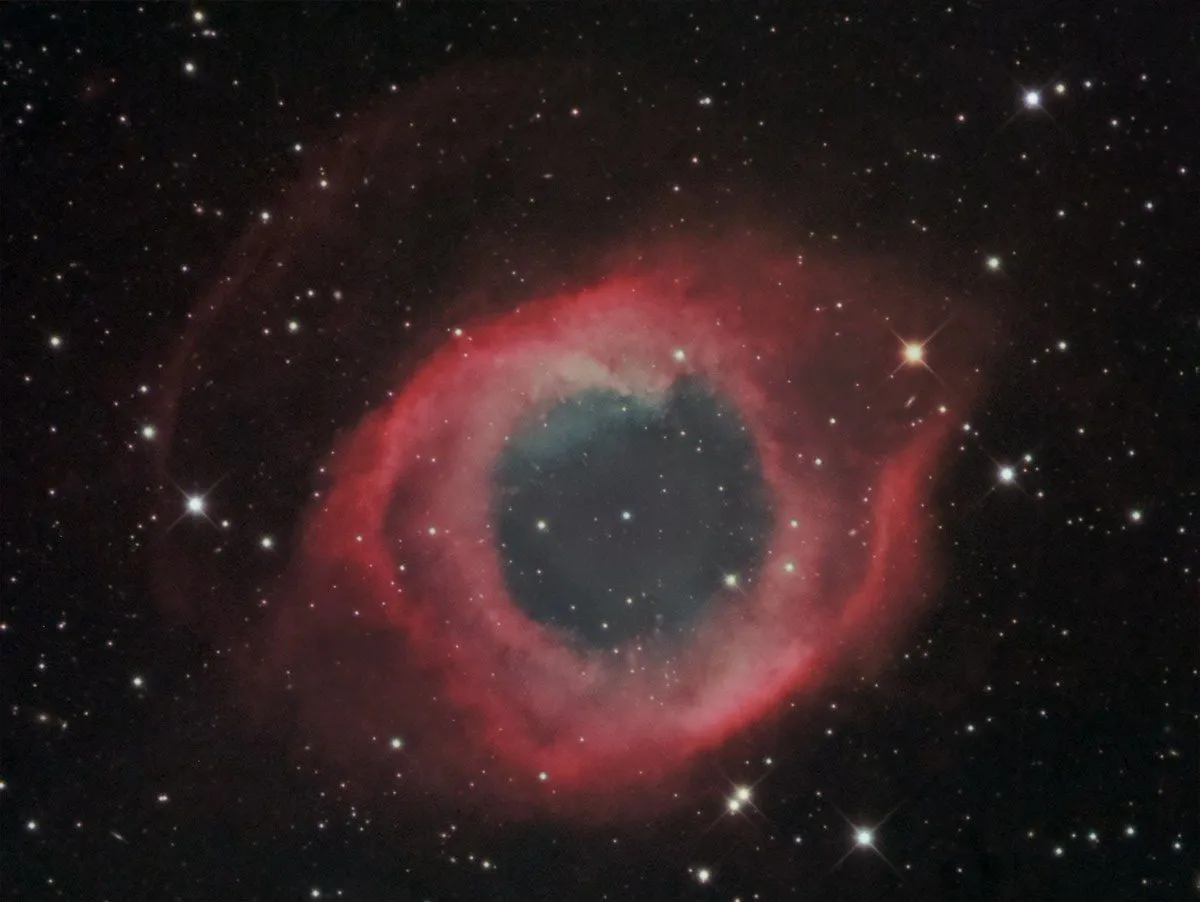
The Helix Nebula
 HD 213056mag 9.91K1(III)HD 213069mag 10.44F5/6(V)BD-21 6241mag 10.62TYC 6391-1496-1mag 11.11BD-21 6232mag 11.11TYC 6391-967-1mag 11.16TYC 6391-936-1mag 12.31Central StarNGC 7293mag 13.52DAO.5UCAC2 23772022mag 13.65
NGC 7293, the Helix Nebula, in LRGB from the Okie-Tex Star Party and Comanche Springs.
Location: Okie-Tex Star Party 2005 and Comanche Springs, 3RF dark sky site near Crowell, Texas
Date: October - November, 2005
Seeing: 2/10
Transparency: 6/10
Temperature: Chilly (-25 and -20 degrees C on camera)
Scope/Mount: 12.5" RCOS RC @ f/9 and Paramount ME
Camera: SBIG STL-11000M astro CCD camera
Exposure Info: LRGB image; 420:30:25:30 RGB (20 minute subexposures for L, 5 minute subexposures for RGB, color binned)
Processing Information: Acquisition with CCDSoft. Calibration (darks/flats), registration, gradient removal, and RGB channel combine in CCDStack (median combine). LRGB combine, color balance, levels/curves, and noise removal and local contrast enhancement (Noel Carboni's Astronomy Tools) in Photoshop CS.
Exposure Notes: A difficult object because of the low southern views. Poor seeing, winds, and short RGB data set didn't help. Data taken across five different nights, none of which were spectacular. Interesting note, but this was 7 hours of clear luminance exposure, yet the image was still quite noisy and not very deep…if the data isn't good in quality, it'll likely have low S/N. Not a bad final result, but this one will require a return visit!
- What it is
- The Helix Nebula (NGC 7293) is a planetary nebula — the glowing shell of gas cast off by a dying, Sun-like star — and one of the closest planetary nebulae to Earth.
- Constellation
- Aquarius
- Distance
- ~650 light-years
- Apparent magnitude
- 7.6
- Angular size
- ~25 × 25 arcminutes
- Coordinates
- RA 22h 29m 38s, Dec -20° 50′
This summary was generated by an AI assistant from general astronomical references, not from Jay's own notes on this specific image. Treat every detail above as a starting point for research, not settled fact.